Oliver Sacks called his final, unfinished essay collection The River of Consciousness. He chose the title because it captured something he had been circling his entire career: the sense that consciousness is not a thing but a flow, not a substance but a process, not a fixed structure but something that moves and eddies and sometimes, catastrophically, stops. He mapped the river with more care and honesty than any neurologist of his generation. Every case in his work is a precise observation of what happens to the forms that appear on the river’s surface when something goes wrong.
What Sacks could not say, and what the Myelin Mind proposes, is what the riverbed is made of.
The river


Stand beside a river and watch its surface. Where the water flows over a complex bed, forms appear. Eddies. Surface shapes. Persistent patterns of turbulence organised by the obstacles and channels beneath. Some of these forms are stable enough to name, a particular eddy below the boulder that has been there for years, a surface shape where two currents meet that fishermen know and use. Others are temporary, flickering in response to every leaf that falls and every change in the upstream flow. But all of them arise from the same relationship: the continuous flow of water meeting the structure of the bed that the flow itself has built over time.
The riverbed is not separate from the river. It is what the river has become over years and decades of encounter with the landscape. Every stone in the channel has been placed by the water. Every curve of the bank has been carved by the current. The bed is the accumulated condition of the flow’s own history, inscribed into the geology of the channel. And the forms on the surface are the present encounter of the flow with that history. The river meeting itself, across time, in the only way available to it: through the forms that arise at the intersection of what flows now and what has always flowed before.
This is the chiasm. Grey matter is the flow: the world arriving through the senses moment by moment, the incoming signal of everything that is happening now. White matter is the riverbed: the accumulated biological condition of everything the organism has encountered before, inscribed into myelinated structure over a lifetime of encounter with the world. The form that appears on the surface, the recognisable face, the familiar cup, the word that means something, the sense of a self that persists through time, is the persistent shape produced by the present flow meeting its own accumulated history.
The form is real. The eddy is genuinely there. But it is not a substance. It is an event, maintained dynamically by the ongoing relationship between what flows and what has been built by flowing. Change the flow and the form changes. Block the flow and the form dissolves. Put your hand in the water and the eddy breaks up. Remove your hand and it returns, because the bed is still there. The accumulated condition persists. The chiasm resumes. The form appears again.
Unless the bed itself has eroded.
The forms throughout
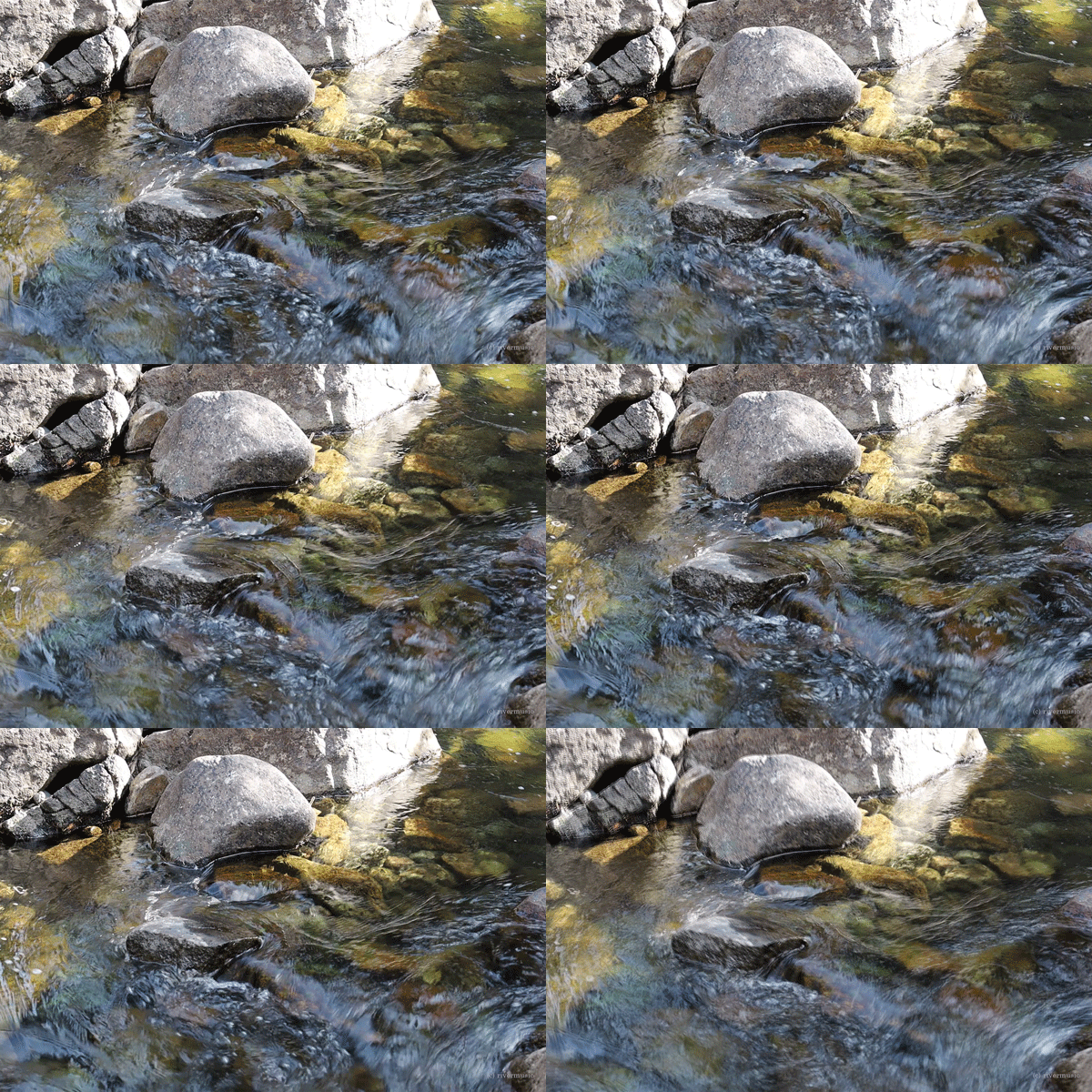
There is something the river analogy adds that no other image captures: the forms are not only on the surface.
The volume of the river, the full three-dimensional movement of water through the channel, contains its own forms throughout. Turbulence patterns. Pressure gradients. The complex internal geometry of a flow that is simultaneously responding to the surface it moves over, the banks that contain it and the resistance of everything it carries. We see the surface forms because we stand on the bank and look down. But the river is full of forms that are not visible from outside, that exist only within the flow itself and can only be known from within.
The Myelin Mind proposes that consciousness is like this. What we can observe from outside, the behaviour, the language, the measurable neural correlates, is the surface. The forms that constitute experience, the persistent shapes of a recognisable world, a continuous self, a life that coheres, exist throughout the volume of the encounter between flow and accumulated condition. They are not only at the surface where the instruments can read them. They are in the full depth of the chiasm, in the ongoing intersection of the incoming signal with the whole layered history of what the organism has been and done and built.
This is why consciousness remains resistant to reduction. The instruments read the surface.
The forms are throughout.
When the bed erodes
Every case in Sacks’s work is a case of the bed eroding, or being damaged, or being suddenly and catastrophically absent.
The man who mistook his wife for a hat was not failing to see. His visual system was intact. The flow was arriving normally. But the accumulated condition that would have produced the recognisable form of his wife’s face from that flow had been selectively damaged by a neurological lesion. The form dissolved. The flow continued. She was there. He could describe her features individually, like a botanist describing a flower by its parts, but the form of her as a recognisable person, the persistent shape that the chiasm normally maintains, was gone. He was reaching into the river and finding no eddy where the eddy should have been.
Jimmie G., the Lost Mariner, could not produce the form of a continuous self across time because the white matter that would have accumulated that continuity had been dismantled by alcohol. Each moment produced its form. He was present, intelligent, engaged. But the forms did not cohere into a life. The river flowed but the bed had no memory. Each eddy appeared and dissolved without leaving a trace in the structure that the next eddy would have to form from. He was marooned in a perpetual surface without depth.
Christina, the Disembodied Lady, lost her proprioceptive accumulated condition overnight through an inflammatory neuropathy. The body schema, the myelinated rhizome that normally produces the persistent form of a self extended through every limb, dissolved. The flow of movement continued but the form of inhabiting a body was gone. She had to reconstruct it visually, watching her own limbs move in order to produce a thin, effortful version of the form that the accumulated condition had previously maintained without any conscious attention. She was navigating the river by watching its surface from outside rather than feeling the current from within.
Sacks described all of these cases with extraordinary precision. He could see exactly what had been lost and what remained. He could not say what the lost thing was made of.
The riverbed. That is what he was missing. Every mystery in his work is a mystery about the bed: about what maintains the forms, about what happens when the structure that the flow has built over a lifetime is damaged or disrupted or suddenly absent. He kept asking: what is the self, what does it require, what happens when it fails?
He had the river. He did not have the geology.
Or so it seemed.
The periodic table on his desk
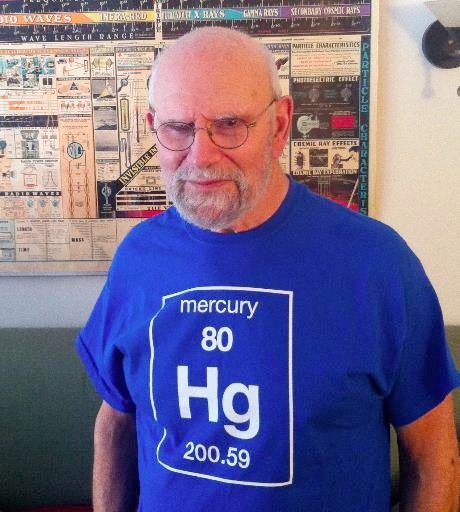
Here is what makes Sacks’s story sad, strange and precise and, in retrospect, almost unbearably close.
Sacks was, alongside his career in clinical neurology, quietly obsessed with geology and with the periodic table. He collected samples of pure elements, pieces of bismuth, wafers of thallium, chunks of sulphur, ingots of metals whose names he had loved since childhood. He handled them with a pleasure he described but never fully explained. He was drawn to the stability of elemental structure, to the way each element simply was what it was, its properties arising entirely from its accumulated architecture rather than being imposed from outside.
This was not an eccentric hobby sitting beside his clinical work. It was the same question approaching from the opposite direction.
The periodic table is the taxonomy of accumulated elemental structure. Each element is what it is because of the precise arrangement of its subatomic architecture, built up through the history of stellar nucleosynthesis over billions of years. The elements do not perform their properties. They are their properties, because of what they have accumulated into themselves. A piece of bismuth is not labelled bismuth and then assigned bismuth’s properties. It is bismuth because of what it has become through the history of its own structural accumulation. The form and the history are the same thing.
When Sacks held a piece of pure bismuth or a wafer of thallium, he was holding, without the language to say so, the closest analogy the inorganic world offers to the myelinated self. A structure that is what it has accumulated. A persistent form arising from the history of what has been built up within it. A stable identity maintained by internal architecture rather than external imposition.
The periodic table was calling to him because it was describing, in the language of chemistry, the thing he had been trying to say about the self his entire clinical career. Every element is a different accumulated structure producing a different set of persistent properties. Every self is a different myelinated bed producing a different set of chiasmic forms. The table was the taxonomy he needed. The geology was the metaphor that kept drawing him back.
He spent his life with the river in one hand and the bed in the other, and the two never quite met. The neurology gave him the flow, the cases, the clinical precision of what happens when the forms dissolve. The geology gave him the weight of accumulated structure, the felt sense of something that simply is what it has become. Two projects. Two obsessions. Two approaches to the same question arriving from opposite planes, the flow of consciousness in his clinic and the weight of elemental accumulation on his desk, orbiting each other across an entire career without finding the bridge between them.
The Myelin Mind is that bridge. The riverbed is made of myelin. The accumulated biological structure that the flow of a life builds over time, inscribed into white matter through every encounter and every productive struggle and every language learned by necessity, is what produces the persistent forms of a recognisable world and a continuous self. It is, in the precise sense that Sacks felt in his hands without being able to say, the geology of consciousness.
He named the river. He held the bed. He never connected the two.
The Myelin Mind is proposing that they were always the same thing.
The forms that appear
Stand beside the river. Watch the surface.
The forms that appear are not hallucinations. They are not projections of a mind onto a neutral world. They are the persistent shapes produced by the ongoing encounter of flow and accumulated structure, arising at the intersection of what is happening now and everything that has happened before. They are real in the way that eddies are real: genuinely there, consistent enough to name and point to, maintained dynamically by the conditions that produce them.
The cup on the table is an eddy. The face of the person you love is an eddy. The word that means something is an eddy. The self that persists through time, that wakes each morning with a sense of continuity with the self that went to sleep, is an eddy. All of them are persistent forms produced by the chiasm, by the intersection of the incoming flow of the present moment with the accumulated myelinated structure of everything that has been lived before.
They feel substantial. They feel given. They feel like the furniture of a world that was always there and will always be there. But they are maintained dynamically, moment by moment, by the ongoing encounter of flow and bed. Block the flow and they dissolve. Erode the bed and they disappear. Disrupt the relationship between them and they flicker, fragment, take unfamiliar shapes.
This is what Sacks spent his career documenting, with the care and precision and humanity that made him the greatest clinical narrator of the twentieth century. He mapped every way the forms can fail. He named the river. He held the periodic table and felt its weight and knew it was telling him something he could not yet say.
The riverbed was in his hands all along.

In a way, Sacks wrote this article not me…
Not intentionally.
But the forms he left behind, the river, the periodic table, all the cases of beds eroding and flows continuing, arrived in my hands like a letter in a bottle.
I was just drawn to the shape of it. I followed the shape and found the myelinated geology.
I have been reading his works to my son for years as bedtime stories. He often reflects that not many of the stories have happy endings – often the story subject dies in the end. Slowly I realized that it all constituted the story of life itself – which rarely has a happy ending- but I think Oliver would be pleased with this story.
Thank you Oliver, the message in your bottle was received, with admiration, love and respect for a geo-neuro-myelo-ntologist of the highest order.
Jack Parry is a philosopher, polyglot and biomedical animator at Swinburne University of Technology. He is the author of The Myelin Mind: The Genesis of Meaning.