Recent Articles

An alternative theory of mind & consciousness
The Genesis of Meaning
Neuroscience has spent a century mapping the neuron. But the answer was hiding in the white matter all along. Myelin, the sheath you were never told about, is the biological substrate of memory, habit, consciousness, and selfhood.
My father is a careful man, not given to loose comparisons. He meant the structure of the event. The sudden blindness. The encounter with something in the blindness. The restoration of sight that left a different person looking through the same eyes.
I had had a stroke. An occipital event, as the neurologists described it, affecting the visual processing regions at the back of the brain. What followed is described in more clinical detail in the Persistence of Vision article on this site. Six months of visual fog. Confabulation, which is to say hallucination with full conviction, the brain generating a world it could no longer receive properly from the outside. My visual cortex, intact but deafferented, generating experience from its own accumulated reserves rather than from the world.
Charles Bonnet syndrome, before I had a name for it.
Paul, on the road to Damascus, saw a light brighter than the sun and fell from his horse. He was blind for three days. When Ananias restored his sight, everything had changed. The man who had been Saul, who had been certain of his ground and his purpose, was gone. What remained was someone who had encountered something in the blindness and could not un-encounter it.
The medical literature has spent considerable energy diagnosing Paul retrospectively. Temporal lobe epilepsy is the most common suggestion. Migraine with aura. Possibly a conversion disorder in the psychoanalytic sense. None of these diagnoses are inconsistent with what is described, and none of them diminish what happened. A seizure that reorganises an entire life is not less significant for being a seizure. The encounter is real regardless of its substrate.
My father's point was simpler than any diagnosis. He was noting that the structure of the event, sudden blindness, something encountered in the darkness, sight restored and different, was a structure he recognised from the oldest account of it he knew. He was not saying I had seen Christ. He was saying I had been on the road to Damascus, and that whatever I saw in the blindness was mine, and that I should pay attention to it.
What I saw, when my sight came back, was myelin.
Not literally. I did not see the white matter of my own brain glowing in the dark. What I mean is this: the experience of losing sight and recovering it partially, of living for months in a world partly generated by my own accumulated visual condition rather than by the world outside, left me unable to stop thinking about the substrate of that experience. What was it that was generating the images I saw during confabulation? What was it that persisted, intact and productive, when the incoming signal from the world had been so severely disrupted?
The answer I eventually arrived at was white matter. The myelinated record of a lifetime of seeing, built up over decades of visual encounter and consolidated through sleep and experience, was still there when the pathway from the retina to the cortex was damaged. It continued to generate experience, as Charles Bonnet's patients' white matter continues to generate experience when their retinas fail. The chiasm, the encounter between incoming grey matter and accumulated white matter, was still firing, but it was firing from one side only.
The thesis that became The Myelin Mind was born in that blindness. Not from reading, though there was a great deal of reading. From the experience itself, which forced a question the standard neuroscientific account did not have an answer for: what exactly is it that persists when the incoming signal fails, and continues to generate the full texture of conscious experience from its own interior?
My father's Damascus framing has stayed with me. I have turned it over many times, and I think what he was pointing at, though he would not have put it this way, is that certain encounters with one's own accumulated condition are so deep and so complete that they reorganise the entire self around a new understanding.
Paul did not see God. Or rather, whether he saw God is not a question I am equipped to answer. What he encountered, in the blindness, in the three days of darkness and the voice from nowhere, was something so far inside his own accumulated condition that it felt like the ground of everything. Something that spoke from beneath the ordinary flow of incoming signal. Something that the Myelin Mind would describe as the white matter speaking from its own deepest inscription.
In a certain framing, that is what conversation with God has always been. Not a signal from outside the nervous system but the accumulated condition of a particular life, myelinated over years of encounter and longing and attention, speaking from its own interior in the silence that sometimes follows blindness.
I do not claim religious experience. I claim a stroke and its aftermath, and the thought that arrived in the recovery.
But I understand, in a way I did not before the road to Damascus, why the experience of encountering one's own white matter in the dark might be indistinguishable, from the inside, from the experience of encountering something that was always larger than oneself.
The accumulated condition of a life, encountered without the noise of the present, in the full silence of deafferentation, is not a small thing. It is everything you have ever been. Speaking to you. For the first time without interruption.
Whether you call that God or myelin depends on the century your father was born in and the language he gave you.
My father is now, and he gave me myelin.
The book was written with animated visual figures that enact the argument rather than merely illustrate it. The Hume cylinder. The Bergson cone. The Deleuze spiral. The Destiny vortex.
These animations are being assembled into a short documentary communicating the Myelin Mind thesis to a general audience. As each piece is completed, it will live here.
View the inverted mind hypothesis →Finally an ANSWER to the meaning of life
The core argument
The brain contains two kinds of cells: neurons (grey matter) and glial cells (white matter). For over a century, neuroscience has focused almost entirely on neurons, treating myelin as mere insulation, a passive support structure for the "real" work of the brain.
The Myelin Mind inverts this assumption. Myelin is not passive. It is the material condition of a lived life, the biological substrate of habit, memory, skill, and the sense of self. The encounter between grey matter (the world arriving through the senses) and white matter (the accumulated condition of experience) is what produces consciousness, meaning, and selfhood.
This encounter I call the chiasm (from the Greek letter χ - Chi).
It is the exclusive site of subjective experience.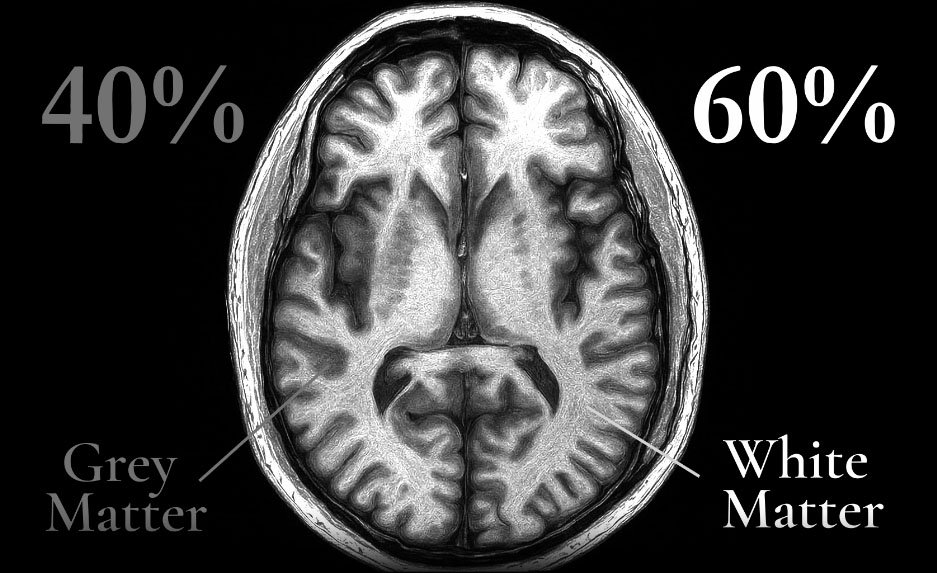

"Consciousness is not what the neuron does alone. It is what happens at the encounter."— The Myelin Mind, Dr Jack Parry
The Myelin Mind is built on a small number of foundational ideas that are each simple to state and together form a coherent account of consciousness, selfhood, memory, time and recovery. Some of these ideas are established neuroscience, seen through a new lens. Others are original proposals, offered as hypotheses rather than settled facts.
Each of these ideas originates in The Myelin Mind: The Genesis of Meaning and are explored further in the articles on this site.
The brain is approximately half neurons and half something else: the myelinated white matter that wraps every axon in the nervous system. For most of the history of neuroscience, white matter has been treated as support tissue, the scaffolding rather than the building. The dominant account of consciousness focuses almost entirely on neurons: signals fire, information processes, mind emerges from sufficient complexity. This is what the Myelin Mind calls the wired mind doctrine, and it is the starting point for everything that follows.
The argument of this project is that white matter is not scaffolding. It is not support tissue. It is the biological substrate of selfhood, memory, habit, skill and conscious experience. The encounter between the incoming neural signal and the accumulated myelinated structure is where experience happens. Not in the neuron alone. Not in the white matter alone. At their meeting.
A newborn foal can walk within fifteen minutes of birth. A human infant takes nearly a year. The difference is not intelligence. It is myelination. The foal is born with mature myelination of its primary motor pathways. The human infant is not. What looks like a developmental delay is actually the slow biological inscription of a nervous system that will eventually be far more sophisticated than the foal's, precisely because it takes longer to build.
Human myelination follows a sequence that maps onto every major developmental milestone. The sensory and autonomic pathways myelinate first, in the womb. Motor pathways follow in early childhood. The frontal and association pathways, the ones responsible for impulse control, planning, empathy and adult judgement, do not complete myelination until the mid-twenties. This is not a cultural observation. It is a biological one. Cognitive adulthood is a myelination phase, not an age. The self arrives slowly, and it arrives as white matter.
The most powerful evidence for the Myelin Mind thesis does not come from healthy brains. It comes from what happens when white matter is damaged, disrupted or systematically destroyed. Multiple sclerosis demyelinates specific pathways and produces not just motor loss but the collapse of continuity, fatigue of will, fragmentation of time, loss of ease in one's own world. Stroke severs myelinated connections and, depending on where, can leave intelligence intact while removing the sense of being oneself. Alzheimer's disease, reframed through the Myelin Mind lens, may not be primarily a disease of memory but of white matter: the systematic dismantling of the biological substance of a self, in the reverse order of its construction.
Alcohol, anaesthesia and the phantom limb all tell the same story from different angles. The sequence in which consciousness dims under alcohol is the precise reverse of the sequence in which the nervous system myelinated. The most recently acquired capacities go first. The most ancient go last. The phantom limb persists because the myelinated body schema of the absent limb is still intact. These are not random clinical observations. They are the biology revealing its own architecture.
White matter is not a record of experience. Records can be retrieved, copied, overwritten and deleted. The accumulated condition of the myelinated nervous system cannot. It is the biological state of the organism as transformed by everything it has lived: every skill practiced, every language acquired, every loss absorbed, every relationship sustained. It is not stored anywhere. It is inscribed throughout.
The philosopher Jacques Derrida described the arche-trace: a past that was never present, a condition for all experience that was never itself experienced as a present moment. The myelinated nervous system may be the biological arche-trace. No organism ever consciously experienced the laying down of its own myelin. The sheath forms in sleep, in development, in the slow metabolic work of oligodendrocytes going about their business below the threshold of awareness. What you are is constituted by a history you never lived as a present moment. The condition of your consciousness is a past that consciousness never touched.
The myelin sheath is a spiral. Layer upon layer of membrane wrapped around the axon, with the newest layer always innermost, closest to the signal, and the oldest layers outermost, most compact, most deeply sedimented. The whole accumulated history of that pathway is present simultaneously in the structure, held in immediate contact by molecular bonds at the paranodal junctions. The sheath does not store time.
It is time
in biological form.
Henri Bergson argued in his famous 1922 debate with Einstein that lived time, duration, is not the same thing as clock time. He was right, but he had no mechanism. The myelin spiral is a candidate for that mechanism. It accumulates and intersects simultaneously: adding the dimension of duration while producing at its core the event of conscious experience. Heidegger said that Being and Time are one thing, not two. The myelin sheath is a biological structure in which that claim finds at least a partial answer.
The nervous system is two things at once. Grey matter carries the present signal: the world arriving through the senses right now, moment by moment, the incoming flow of neural activity. White matter carries the accumulated condition: the biological history of the organism, everything that has been lived and inscribed into myelinated structure over a lifetime. These two systems are always meeting.
At every myelinated axon, throughout the nervous system, the incoming signal encounters the accumulated condition. This encounter is the chiasm (the greek letter X). The word comes from the philosopher Maurice Merleau-Ponty, who used it to describe the reversible, folded relationship between the touching and the touched, the self and the world. The Myelin Mind uses it to name the biological event at which experience arises: not in the neuron alone, not in the white matter alone, but at their meeting. The chiasm is not a location. It is an event. And it is happening continuously, throughout your nervous system, right now.
The dominant account of consciousness treats it as an emergent property: given sufficient neural complexity, given enough firing in the right patterns, experience simply arises. On this account, consciousness is what the brain produces when it reaches a certain threshold of activity. The Myelin Mind proposes something different. Consciousness is not an emergent property of complexity. It is the ongoing event of an encounter between two different kinds of biological tissue.
This distinction matters for how we understand everything from sleep to stroke to the nature of the self. If consciousness is emergence, then more neural activity means more consciousness and less means less. If consciousness is encounter, then what matters is not the quantity of activity but the quality of the meeting: what kind of signal is arriving, what kind of accumulated condition it is encountering, and whether the conditions for coupling are present.
When a neural pathway is activated under conditions of genuine effort and meaningful purpose, the metabolic demand on the surrounding tissue increases sharply. Astrocytes, the star-shaped glial cells that support and supply the neurons, respond by shuttling lactate to the active axons. Lactate is both the fuel for intense neural activity and the signal that recruits oligodendrocytes, the myelin-producing cells of the nervous system. The oligodendrocyte lays down myelin, and the pathway becomes faster, more reliable and more automatic.
The struggle is not incidental to the process. The struggle is the signal. Meaningful repetition in a purposeful context generates a stronger and more directed lactate signal than repetition in a void. This explains why task-specific rehabilitation outperforms non-specific exercise, why a language learned under conditions of necessity is inscribed more deeply than one studied in a classroom, and why meaningful practice in any domain produces durable change while rote repetition does not.
The philosopher Maurice Merleau-Ponty described the intentional arc as the felt trajectory from wanting to do something, through the process of doing it, to its completion in the world. It is the lived continuity between intention and action, the way the body already knows where it is going before it gets there. When you reach for a cup, your hand begins to shape itself for the cup before it arrives. The movement is not a sequence of positions. It is a projection toward a destination.
Neurological damage severs the intentional arc. Not always at the same point, and not always in the same way, but the rupture between wanting and being able to is one of the most characteristic features of neurological damage. The Myelin Mind proposes that this arc is biological: it is sustained by the myelinated pathways that connect intention to execution, and rehabilitation is the process of rebuilding those pathways through meaningful, purposeful, repeated engagement with the world. The arc does not rewire. It remyelinates.
Sleep appears in the evolutionary record at almost exactly the point where myelination appears: in jawed vertebrates. This is not coincidence. The Myelin Mind thesis proposes that sleep is the periodic decoupling of the chiasm, the temporary separation of grey matter signal from white matter structure, so that the accumulated condition can be edited, updated and consolidated without the interference of ongoing neural activity.
During waking life, the chiasm is continuously forming. The incoming signal is always meeting the accumulated condition, and every encounter leaves a trace. Sleep is when the white matter processes those traces, discarding what is redundant, reinforcing what matters, updating the accumulated condition for the next day's encounters. Dreams, on this account, are the experiential residue of that editing process: the sound the myelination machinery makes while it works.
The sequence in which the nervous system loses function under any form of global disruption, alcohol, anaesthesia, advancing dementia, is always the same. The most recently myelinated structures fail first. The most ancient and deeply inscribed fail last. Under alcohol, high cortical judgement softens before language slurs, language slurs before coordination fails, coordination fails before consciousness dissolves. The sequence is the reverse of the myelination timeline.
The self is not a uniform entity that degrades evenly. It is a layered structure, the most recent acquisitions always outermost and most vulnerable, the most ancient always innermost and most protected. The drunk person is not a degraded self. They are a temporally earlier self, operating with the myelinated structures that were in place before the recent ones arrived. Recovery, in any context, follows the same sequence in reverse: the ancient structures first, the sophisticated ones last.
Oliver Sacks described a patient he called Jimmie G., a former sailor whose memory had been destroyed by alcohol. Jimmie was intelligent, charming, articulate. He could hold a conversation, solve a puzzle, navigate a room. But he could not carry the present moment forward into the next one. Each moment arrived fresh, weightless, disconnected from what had come before. He was marooned in a perpetual, vanishing present.
The Myelin Mind argues that artificial intelligence resembles the Lost Mariner in a precise sense. It possesses extraordinary competence within the immediate moment. It cannot carry that moment forward into duration. Every new engagement (like a new chat) is a fresh awakening into a world that is always new and therefore always weightless. This is not a limitation that more processing power will solve. It is an architectural condition. AI has no myelinated nervous system. It has no accumulated condition inscribed through a lifetime of metabolic encounter with the world. What AI lacks is not intelligence. It is the biological substance of time.

Ch. 01
When a common asthma drug dismantles a person's reality, it opens a precise and unsettling question about what myelin actually does.
→Ch. 02
Consciousness is always consciousness of something. The lioness cannot see the zebra. The zebra is genuinely not there for her. Why?
→Ch. 03
The biology of myelinating glial cells: what they are, what they do, and why they have been hiding in plain sight in every diagram of the brain.
→Ch. 04
What would it mean to genuinely change your mind? Myelination as the biological basis of transformation, and why real change is always slow.
→Ch. 05
From the infant learning its first language to the expert whose skill has become effortless: myelination is the biological inscription of lived experience.
→Ch. 06
Why myelin requires sleep, why learning is slow, and why this biological pace is not an inconvenience but a requirement for a stable self.
→Ch. 07
Connections to Deleuze, Husserl, Merleau-Ponty, Sartre, Bergson. The chiasm as the biological for-itself. The brain-in-a-vat refuted anatomically.
→Ch. 08
Multiple sclerosis, Alzheimer's, PTSD, alcohol. When myelin fails, the chiasm dissolves, and with it the self and its sense of time.
→Ch. 09
When myelin fails, it is not merely speed that is lost. It is the intentional arc that holds a life together. MS, Parkinson's, and the dissolution of self.
→Ch. 10
The oligodendrocyte rhizome as the individuated mind. The biological thing which thinks. Why no two minds can ever be the same.
→Ch. 11
A mind is not a database to be computed but a history to be lived. Why artificial intelligence lacks the metabolic inscription that defines a human mind.
→Demyelination as the progressive dissolution of the intentional arc, not a failure of speed but a theft of agency and selfhood across time.
The unravelling of white matter as the unravelling of lived history, when the inscription of a life is erased by the mind that lived it.
Hypermyelination as the overinscription of a traumatic past as the condition of all present moments, a single experience etched so deeply it shapes all other future encounters.
The temporary decoupling of the chiasm, why alcohol feels like freedom from the self, and what it reveals about the architecture of consciousness.

Philosopher, polyglot, biomedical animator and lecturer at Swinburne University of Technology in Melbourne, Australia.
Research into the Myelin Mind was initiated by a personal experience of stroke-induced blindness. The sudden, terrifying dissolution of a visual world that had seemed utterly reliable. That experience became a philosophical and scientific question: what kind of biology makes the world appear, and what kind of failure makes it disappear?
His work bridges the chasm between the objective brain of neuroscience and the singular, subjective reality of the living conscious mind. The Myelin Mind: The Genesis of Meaning is currently under consideration at Melbourne University Publishing and Allen & Unwin.
The Myelin Mind
© 2026 Dr. Jack Parry. All rights reserved.