keywords: platypus mind

Pedro is my Peruvian PhD student currently living in Tasmania writing his PhD by practice-led research (animation) – Splashing in Serendipity. He is Peruvian, which means he arrived in the southern hemisphere already comfortable with strangeness, and he brought with him a word that has become my own preferred description of himself:
PELOTUDO
It is South American slang, that I roughly translate in my own terms – directly towards him – as someone who
…thinks too much about the wrong things in exactly the right way.
Pedro taught it to me. I have been using it ever since, mostly about myself.
Pedro has built his metaphysical world around the platypus. Not just as a research subject. As a structure for understanding himself and the world. When your colleagues ask what your thesis is about and you tell them it involves a semi-aquatic monotreme with a duck bill, a beaver tail, venomous ankle spurs and the ability to navigate underwater with its eyes closed, you have committed to a certain kind of intellectual life. Pedro committed early and has not looked back.
Just today we met online for our weekly supervision meeting, which is the disembodied, dark, electrically mediated space (not too much unlike the world of the platypus) where thinking actually happens now, and asked me a question that turned out to be one of the most productive questions anyone has asked me in years.
He wanted to know:
if the platypus navigates the world with its eyes closed, seeing through electrical fields rather than light, does it experience space the way we do? Is there a horizon? Is there a vanishing point? Is there a there at all, in the Cartesian sense?
I told him I did not know. Then I went and found out. And it turns out that Pedro, in the way of all the best pelotudos, had stumbled onto something extraordinary.
The geometry of the open eye
Before we get to the platypus, we need to understand what we are comparing it to.
The geometry of human visual experience is Cartesian. This is not accidental. René Descartes derived his three-dimensional coordinate system from the geometry of the eye: a single point of observation, a cone of vision projecting outward to a horizon, space organised around the straight line from the observer to the object. X, Y and Z. Left and right, up and down, near and far.
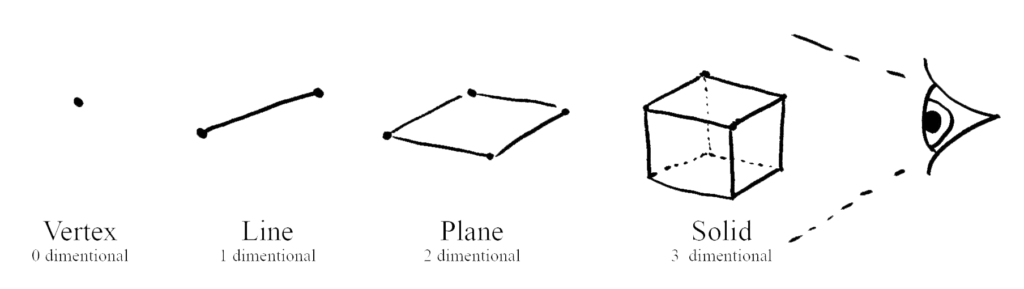
A universe organised around where I am standing and what I can see from here.
When Einstein added time as a fourth dimension to this geometry, he was extending a structure that was already built for creatures with eyes open and a horizon in front of them. His spacetime is the universe as seen from inside a skull with two forward-facing eyes and a strong preference for straight lines.
This is not a criticism. It is an observation. The geometry works. It has generated extraordinary science and technology. But it is the geometry of one kind of mind, navigating one kind of world, using one kind of sensory apparatus.
Pedro’s question was: what geometry does a different kind of mind produce?
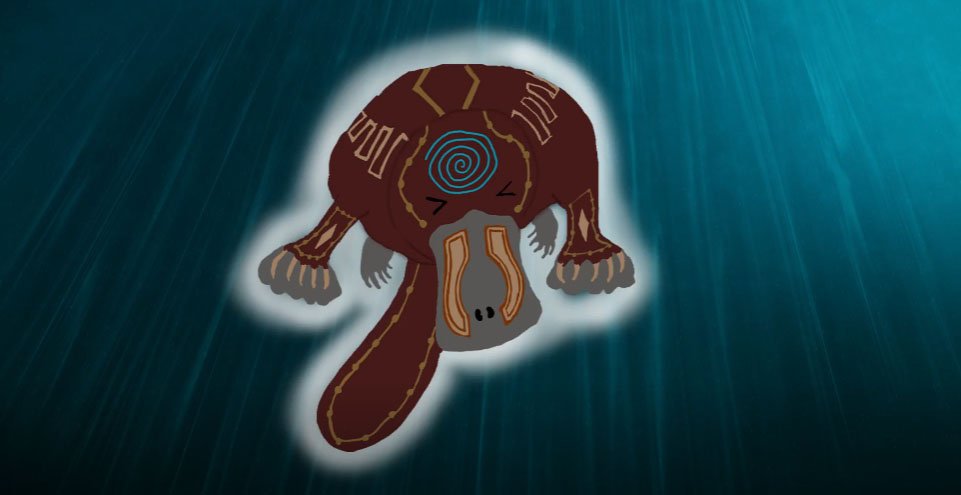
A frame from Pedro’s PhD practice-led animation project “Splashing in Serendipity”
(c) 2026 Pedro Allemant – the spiral was there before I spoke to him
The platypus closes its eyes
When the platypus dives, it closes its eyes. It also closes its ears and its nostrils. It enters the water in a state of voluntary sensory deprivation that would terrify most mammals and navigates entirely through electroreception, the detection of electrical fields generated by the muscle contractions of its prey.
The bill of the platypus is covered in approximately 40,000 electroreceptors arranged in horizontal stripes. These receptors detect the tiny electrical pulses produced by the nervous systems of shrimp, worms and insect larvae moving in the sediment. The platypus does not see its prey. It feels the electrical signature of its prey’s existence.
But here is the part that answers Pedro’s question.
The platypus does not navigate in straight lines. It sweeps. It moves its bill from side to side in a slow, continuous arc, triangulating the source of electrical signals by comparing the timing and intensity across its receptor stripes. That sweeping motion is a spiral search pattern through three-dimensional water space. The platypus is not projecting a cone of vision forward to a horizon. It is drawing spirals through the world, reading the curl of electrical fields as it goes.
There is no horizon for the platypus. There is no vanishing point. There is no X, Y and Z organised around a forward-facing observer.
There is a field, and a curl, and a signal moving through water, and a bill sweeping in arcs to find it.
The geometry is not Cartesian. It is rotational. It is, in the most precise sense available to us, spiral.
What the platypus teaches Bergson
In the previous article in this series, I argued that Henri Bergson lost his famous 1922 debate with Einstein not because he was wrong but because he lacked a mechanism. Bergson insisted that lived time, duration, was not the same thing as clock time. He was right. But he could not say what duration was made of, and without a mechanism Einstein’s dismissal stood.
The mechanism, I argued, is myelin. The myelinated nervous system accumulates the past as biological structure and intersects it with the present signal to produce the chiasm: the event at which lived time is generated. Not clock time. Duration.
The platypus confirms this from an unexpected angle. It is myelinated. Its nervous system accumulates condition exactly as ours does. The chiasm is happening in the bill and the brain of every diving platypus. Duration is being produced. Being is time for the platypus exactly as it is for us.
But the spatial geometry of its experience is completely different. The platypus does not organise its world around a horizon because it has no horizon. It organises its world around the curl of a field, around the spiral sweep of a bill through water, around the temporal signature of a muscle contraction fifty milliseconds ago and the predicted location of the creature that produced it.
Bergson said that lived time is the thickness of the present, the whole accumulated past pressing into the current moment. For the platypus, that thickness is not organised spatially at all. It is organised rotationally. The platypus lives in a world of when, not where.
If Einstein’s four-dimensional spacetime is the geometry of the open-eyed, horizon-seeking, Cartesian mind, then the platypus is navigating a world that spacetime cannot fully describe. Not because the physics is wrong. But because the physics was derived from the wrong animal.
Enter the octopus
The platypus is not the only creature that puts pressure on Cartesian geometry from below.
The octopus has no compact myelin. It is the creature we have discussed elsewhere in this series as the counterpoint to the myelinated mind: a nervous system that shows structured sleep and apparent dreaming, that solves complex problems and displays what looks remarkably like personality, but that builds its accumulated condition through a different biological architecture. Nine brains. Eight arms that think semi-independently. A self that is not centred on a single perspective but distributed across a body that can move in nine directions simultaneously.
The octopus is also colourblind. And yet it produces the most sophisticated colour camouflage in the animal kingdom, matching not just colour but texture and pattern to its immediate environment with a speed and precision that no visual system should be able to achieve without seeing colour. The current hypothesis is that it reads polarised light through its photoreceptors, which are arranged in a rotating pattern that gives it access to information about light that the eye’s colour channels cannot provide.
Rotating. Again.
The octopus, like the platypus, is navigating a world organised around rotation rather than straight lines. It is reading the curl of polarised light the way the platypus reads the curl of an electric field.
Both are solving the problem of navigating a world by attending to what rotates rather than what extends.
And both are producing experience. Both are generating a self that encounters a world. Both are, in the Myelin Mind’s terms, producing a chiasm between accumulated condition and incoming signal. The geometry of that chiasm, the shape of the experienced world, is spiral in both cases.
This is not coincidence. It is the geometry of experience for creatures that have solved the problem of navigation without the straight line.
The spiral all the way down
Which brings us back to where the Myelin Mind series has been heading for some time now.
The myelin sheath is a spiral. Layer upon layer of membrane, the newest innermost closest to the signal, the oldest outermost most deeply sedimented, held together by molecular bonds at the paranodal junctions. The accumulated condition of a life, folded into a rotating biological structure, pressing outward from the axon into the present moment of every experience.
The platypus navigates by reading spirals in the world. Its bill sweeps in spiral arcs. The electrical fields it reads are rotationally structured. Its nervous system, like ours, is a spiral accumulator of time.
The octopus reads the rotation of polarised light. Its distributed nervous system solves problems through the spiral logic of nine semi-independent processors working in parallel rather than in sequence.
The geometry of experience, for creatures that are not organised around the straight line of Cartesian perspective, is spiral. Not as a metaphor. As a description of the actual structure of how they navigate, how they accumulate, how they encounter the world.
Pedro’s question was: does the platypus experience space the way we do?
My best answer is (most likely): probably not. The platypus probably does not experience space at all, in the Cartesian sense. It more likely experiences just time. It experiences the curl and rotation of a world made of electrical fields and temporal signatures. It probably experiences duration, in Bergson’s precise sense, without the spatial scaffolding that Cartesian geometry provides.
And its nervous system, like ours, builds that experience on a spiral biological substrate that is itself the accumulation of time made flesh.
The platypus probably does not see the world. It spirals through it. And in doing so, it shows us something that Einstein’s geometry cannot contain: that the experienced universe is not necessarily four-dimensional. It is as many dimensions as the organism’s myelinated history has accumulated, intersecting with as many dimensions as the incoming signal carries, producing a chiasm whose geometry depends entirely on what is meeting and what has been lived.
Bergson had the more open question.
The platypus has a more honest answer.
Pedro, the best kind of pelotudo, found the question in the first place.

Jack Parry is a philosopher, polyglot and biomedical animator at Swinburne University of Technology. He is the author of The Myelin Mind: The Genesis of Meaning.