keywords: being mind myelin translation
 The Myelin Mind : The Genesis of Meaning
 L’Être Myélinique : La Genèse du Sens
 El Ser Mielínico : La Génesis del Sentido
 Das Myelinische Sein : Die Genese des Sinns
Four titles. One book. One biological structure.
Four different encounters with the same reality, each one slightly different from the others, each one losing something the others keep, each one keeping something the others lose.
This is not a failure of translation. It is my thesis.
Translation : Das Problem
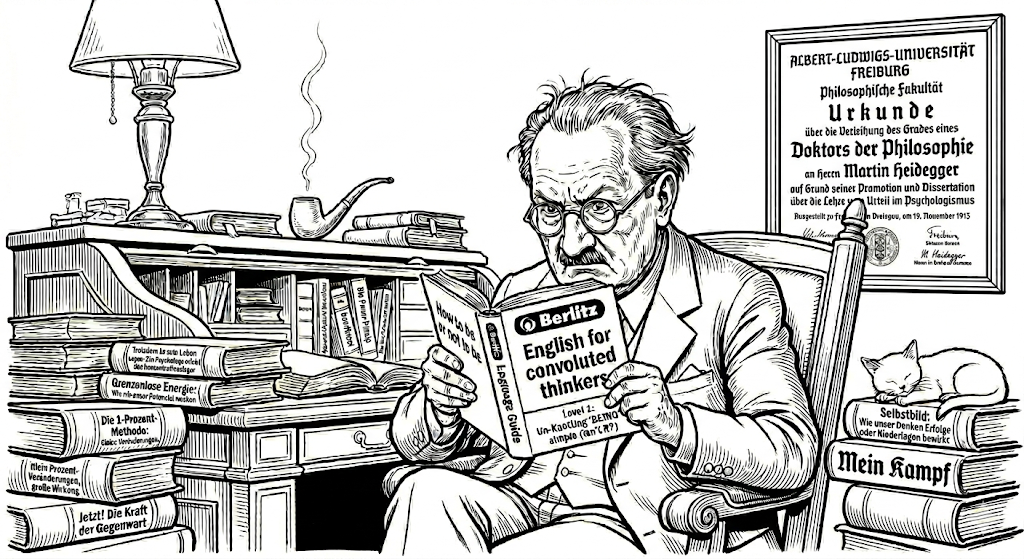
Heidegger spent the better part of a career insisting that Sein cannot be translated. Not because he was being difficult, though he was sometimes being difficult. But because he understood something precise about the relationship between language and thought that most translators prefer not to confront: a word is not a label attached to a concept. A word is an accumulated condition. It is the myelinated residue of every encounter a linguistic community has ever had with the reality the word names.
Sein is not Being. Being is a perfectly good English word that means something. But it does not mean what Sein means, because English speakers have not lived in German, have not read Luther’s Bible in the language in which it was written, have not heard Meister Eckhart preaching das Sein ist Gott, have not felt the weight of a language in which the verb to be carries the full freight of ontological anxiety that German accumulated across five centuries of philosophical and theological wrestling with existence itself.
Sein ist das, was am nächsten liegt. Being is what lies nearest. Heidegger wrote that. Every translator renders it differently. None of them are wrong. None of them are right. Because nearest is not nächsten and what lies is not das, was and the cumulative difference between those small failures is the shape of a mind that did not grow up speaking German.
L’esprit n’a rien à voir avec « the mind »
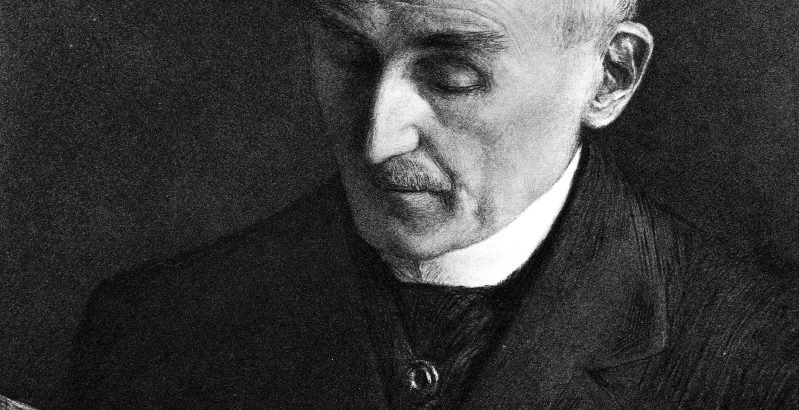
Bergson had the same problem in reverse.
His books were translated into English and the translations made him sound like a mystic. L’évolution créatrice became Creative Evolution, which is fine. La pensée et le mouvant became The Creative Mind, which is not fine at all. La pensée et le mouvant means thought and movement, or thinking and what moves, which is precisely what Bergson was arguing: that thought is not a static thing but a dynamic process, a flowing, a durée in miniature. The Creative Mind makes it sound like Bergson was writing a self-help book for artists.
And then there is esprit. Every time Bergson wrote esprit, his English translators wrote mind. But esprit is not mind. Esprit is lighter than mind, more animate, more aerial. It carries the ghost of the Latin spiritus, breath, wind, the thing that moves through you rather than the thing you are.
When Descartes wrote about the union of l’âme et le corps he meant something different from what an English philosopher means by the union of mind and body, because âme carries the full weight of the Christian soul in a way that mind does not, and corps is more bodily, more carnal, more insistently flesh than body.
The mind-body problem in English is a philosophical puzzle. Le problème de l’esprit et du corps in French is a theological wound that never fully healed. These are not the same problem wearing different clothes. They are different problems that happen to share a family resemblance, the way cousins share a face without sharing a history.
Being: Lo que se pierde, lo que se encuentra
Spanish does something neither English nor French can do cleanly.
Sentido. The word means sense, meaning, direction, sensation, and felt experience simultaneously. Un sentido de la vida. A sense of life, a meaning of life, a direction of life, a felt experience of life. All of those at once, in one word, inseparable from each other.
When I translate La Genèse du Sens into English as The Genesis of Meaning, I lose the sensation. When I translate it as The Genesis of Sense, I lose the meaning. English forces a choice that Spanish and French refuse to make.
This is not an accident of vocabulary. It is a different accumulated condition about the relationship between what things mean and what things feel like. In Spanish, meaning and sensation are not two things that happen to be related. They are one thing that has two aspects. El sentido del tiempo is both the meaning of time and the sensation of time and the direction of time and the sense of time. Bergson would have written better in Spanish. The durée would have found a home in sentido that it never quite found in duration.
And ser, the Spanish word for being, is already bifurcated in a way that German and English and French are not. Spanish has two verbs where every other European language has one. Ser is essential being, what you fundamentally are. Estar is contingent being, where you are right now, how you are feeling, what state you are in. El ser mielínico is the myelinated essential being, what you fundamentally are as a biological structure. But the experience of that being, the moment of the chiasm, the encounter between grey matter and white matter right now, in this moment, reading this sentence, is estar. Estoy leyendo. I am reading. Not as a permanent fact but as a present event.
Heidegger struggled his entire career to distinguish between essential and contingent being in a language that gave him only one verb. Spanish handed it to every child who ever learned to conjugate.
Was Myelin tut
And now the turn.
Myelin translates perfectly into every language. La myéline. La mielina. Das Myelin. Myelin. The word travels without loss because it is not a cultural inscription. It is a biological structure. It does not belong to the accumulated condition of any particular linguistic community. It belongs to every nervous system that has ever myelinated a pathway, which is every vertebrate that has ever lived.
This is not a trivial observation. It means that myelin is the substrate that underlies all the accumulated conditions that make translation difficult. The reason Sein does not travel into English is that English speakers have myelinated their encounter with existence differently from German speakers. The reason esprit does not travel into mind is that French speakers and English speakers have inscribed their encounter with interiority through different histories, different literatures, different philosophical and theological struggles, each one leaving a different biological residue in the white matter of the communities that lived them.
A language is a collective myelin. The gaps between languages are the gaps between accumulated conditions. What is lost in translation is not a word. It is the biological history of a different nervous system’s encounter with the world.
Heidegger was right that Sein cannot be translated. But the reason is biological, not mystical. Sein is the word a German-myelinated mind reaches for when it tries to name the encounter between its accumulated condition and the brute fact of its own existence. Being is the word an English-myelinated mind reaches for when it tries to name the same encounter. The words are different because the sheaths are different. The encounter they are trying to name is the same.
Der Unterschied liegt nicht im Sein. Er liegt in der Myelin.
The difference is not in Being. It is in the myelin.
The chiasm that speaks
Which brings us to what myelin can do about it.
The Myelin Mind thesis proposes that consciousness arises at the chiasm: the encounter between the incoming grey matter signal and the accumulated white matter condition. That encounter is always particular. It is always this nervous system, with this history, encountering this signal right now. No two chiasms are identical because no two accumulated conditions are identical.
Language is a chiasm. When a French speaker encounters the word esprit, the incoming signal, the word, meets an accumulated condition built from centuries of French philosophical, theological and literary inscription. The encounter produces a meaning that is not available to an English speaker encountering the word mind, because the accumulated condition is different. The chiasm produces a different experience.
This is not relativism. It is not the claim that all meanings are equally valid or that translation is impossible. It is the claim that translation is always a chiasm: an encounter between the accumulated condition of the target language and the incoming signal of the source text, producing something that is neither purely the original nor purely the translation but the event of their meeting.
The best translators are not the ones who know the most words. They are the ones whose accumulated condition is richest, most layered, most deeply inscribed with multiple linguistic histories. They are, in the precise biological sense, the most myelinated translators. The ones whose white matter carries the most languages as lived conditions rather than learned vocabularies.
C’est pourquoi les meilleurs traducteurs sont toujours aussi des écrivains. It is why the best translators are always also writers. Because writing is the act of myelinating a language from the inside, of building the accumulated condition through productive struggle rather than passive acquisition.
You cannot translate what you have not lived.
You cannot live a language without myelinating it.
Four titles, one structure
The Myelin Mind — The Genesis of Meaning
L’Être Myélinique — La Genèse du Sens
El Ser Mielínico — La Génesis del Sentido
Das Myelinische Sein — Die Genese des Sinns
These are not four translations of the same title.
They are four chiasms between the same biological thesis and four different accumulated conditions. Each one loses something. Each one finds something. The English loses the ontological weight of Être and Sein and Ser. The French loses the cognitive directness of Mind. The Spanish finds sentido and gives the thesis something it did not know it needed. The German finds Sein and brings Heidegger into the room whether we invited him or not.
Together they are more complete than any one of them alone.
Together they triangulate the thesis from four directions, the way the platypus triangulates its prey by sweeping its bill through the electrical field of the world.
The gaps between the titles are not failures. They are data. They are the shape of the chiasm showing through the language, the biological structure of accumulated condition making itself visible at the point where one language cannot quite reach what another one grasps.
Myelin is the one word that does not gap.
Because myelin is what all the other words are made of.
Das Myelin übersetzt sich selbst.
Jack Parry is a philosopher, polyglot and biomedical animator at Swinburne University of Technology. He is the author of The Myelin Mind: The Genesis of Meaning
(and eventually L’Être Myélinique: La Genèse du Sens | El Ser Mielínico: La Génesis del Sentido & | Das Myelinische Sein: Die Genese des Sinns.)