Keywords: Bergson Einstein Time
You know the theory of relativity. You accept it as one of the most important ideas in the history of science. You have probably nodded along to explanations involving clocks on trains, the bending of light, the fabric of spacetime. You understand, in a general sense, that Einstein proposed something extraordinary about the nature of the universe, and that the scientific community has largely agreed with him ever since.
But here is an honest question: does it really make sense to you? Not the equations. Not the mathematics. The felt reality of it. Does the idea that time slows near a massive object, that space and time are aspects of the same geometric fabric, that the universe has no preferred observer, does any of that land as lived truth? Or does it land as something you accept on authority, the way you accept that the inside of the sun is very hot, because the people who have checked seem to agree?
If the honest answer is the second one, you are in good company.
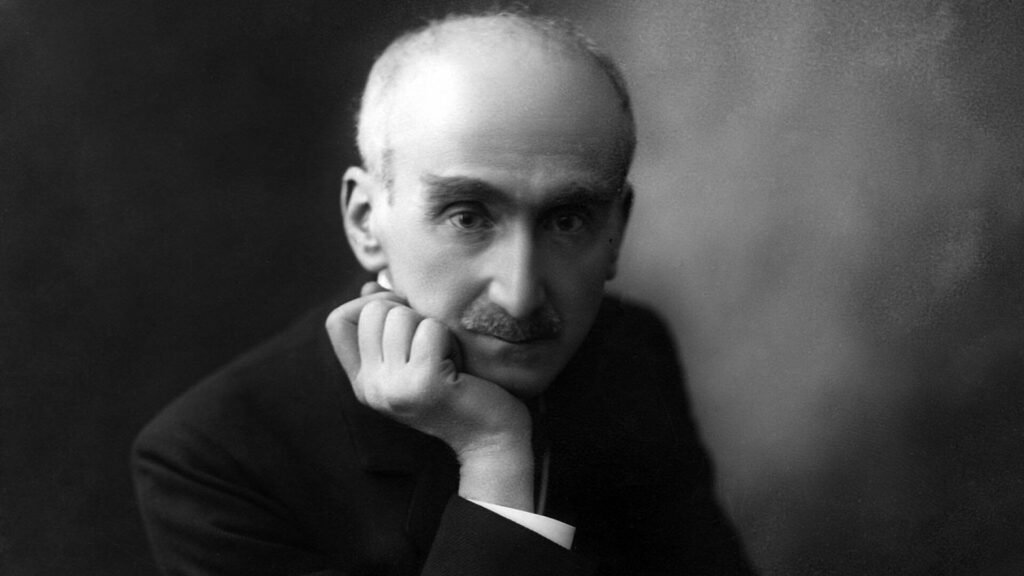
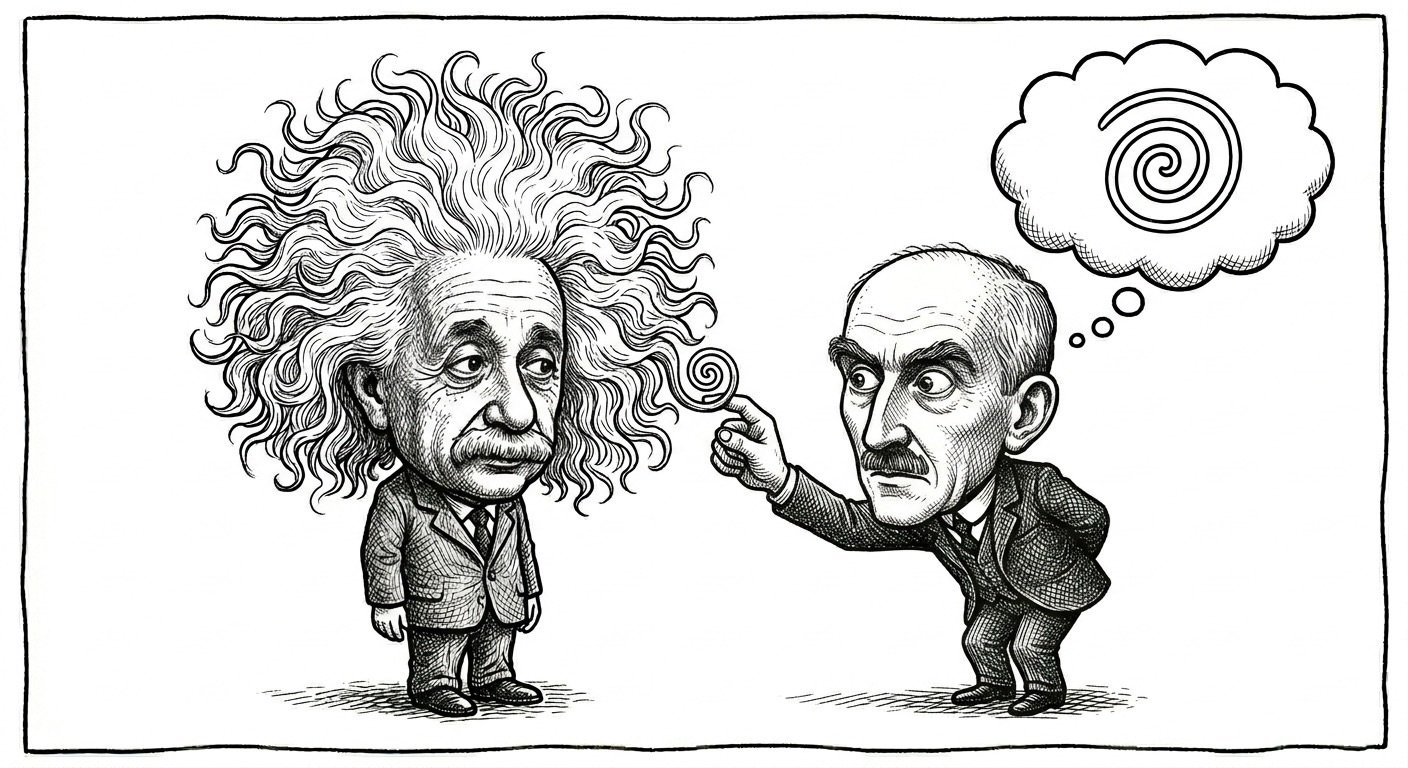
Henri Bergson felt the same way. And Bergson was one of the greatest philosophers of the twentieth century, winner of the Nobel Prize in Literature, the most celebrated intellectual in Europe when Einstein was still a young physicist with a new theory. Bergson did not merely feel uncertain about relativity. He argued, face to face with Einstein, in Paris in 1922, that something essential was missing from the account. That clock time, the time Einstein was describing, was not the same thing as lived time, the time that each of us experiences from the inside. And that a physics which left out the experiencing organism had not fully described the universe.
Einstein won the debate. The scientific community sided with him. Bergson’s reputation as a thinker about time was permanently diminished. The consensus was that he had misunderstood the physics.
I want to suggest that the consensus was too quick. Not because Einstein’s model is wrong. But because no model is reality. A brain and the universe are not made of mathematics. Mathematics is an abstraction, a useful pointer, a finger directed at the moon. The habit of calling a model correct, of treating an abstraction as a fact, is perhaps the most dangerous epistemological move available to a thinking organism. And it is, as we shall see, a deeply biological habit.
Bergson was asking the right question. He just did not have the mechanism to answer it.
I have a suggestion for one. And it requires nothing more than addition and subtraction.
The mathematics you already know
The simple infinite-dimensional logic of the Chiasm
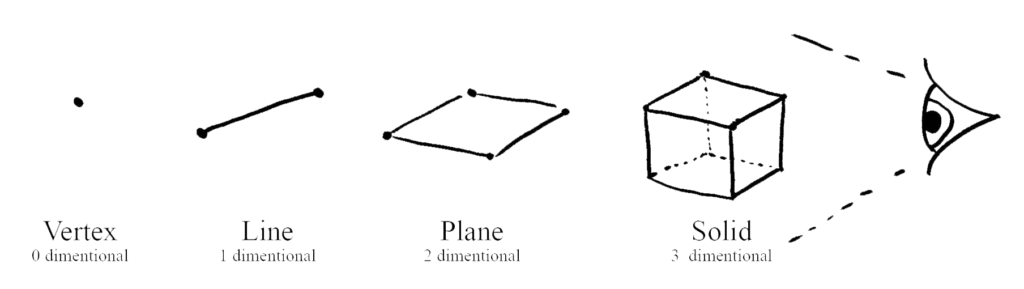
Take a point.
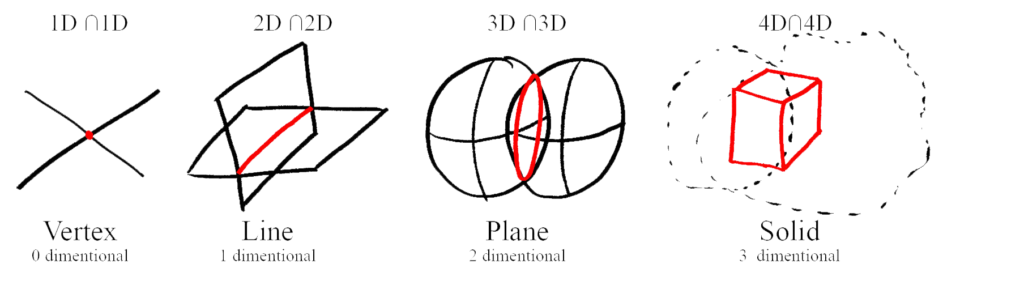
A point has no dimensions. It has no length, no width, no depth. It is simply a location. Now take another point and connect them. You have a line. A line has one dimension: length. Take two lines and cross them. Where they cross, what do you have? A point. Zero dimensions. The intersection of two one-dimensional things produces something with one less dimension.
Take two flat planes and intersect them. Where they cross, what do you have? A line. One dimension. The intersection of two two-dimensional things produces something with one less dimension. Take two solid volumes and intersect them. Where they cross, what do you have? A plane. Something with one less dimension than the volumes that produced it.
The pattern is simple. When two things of n dimensions intersect, their intersection has n minus one dimensions.
The simple infinite-dimensional logic of the Accumulation
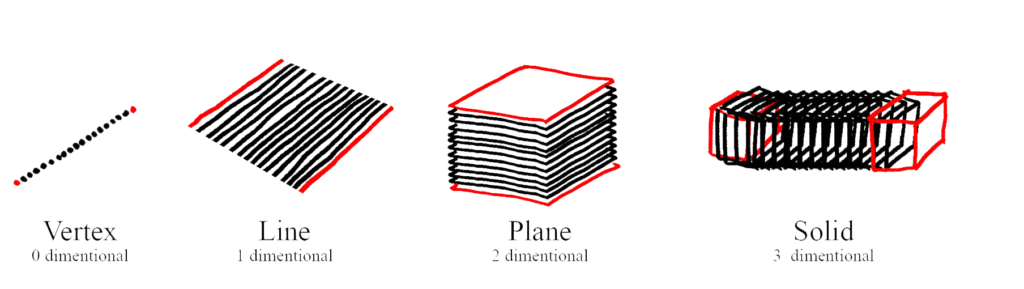
You can run this in reverse. A flow of points producesa line (1-D). A flow of lines producesa plane (2-D). A flow of planes produces a volume (3-D). Accumulation adds a dimension. A flow of solids is therefore 4 dimensional – and a flow of 4D begets a 5D – and so on. Flow increases dimensions – The intersection reduces it. This is not a description of reality.
Reality is not made of mathematics.
This is but a pointer, a useful abstraction that gestures toward something that may be real. With that caveat clearly in place, let us see where the pointer points.
What the debate was really about
Einstein described the universe as having four dimensions: three of space (plus one squeezed in for time).
Cartesian 3D Space + Time
On his account, time is a dimension like the other three, measurable by clocks, consistent across the geometry of spacetime, indifferent to whether anyone is experiencing it. The clocks are the point. The universe runs on clocks. Observers are incidental.
This is a powerful and productive model. It has generated extraordinary predictions and technologies. But it is still a model. And what Bergson noticed in Paris in 1922 was that the model left something out.
There is a time that clocks do not measure. The time you are experiencing right now, reading this sentence, the way the previous word is still somehow present as you read the current one, the way the end of the sentence is already shaping how you read its middle, the way this morning feels different from last night, the way yesterday feels further away than an hour ago. This time, lived time, is not what a clock measures. A clock measures intervals between events. Lived time is the thickness of the present, the accumulation of what has been pressing into what is happening now.
Bergson called this duration. And he told Einstein: your clocks are abstractions. They measure something, perhaps, but they leave out the organism that is doing the measuring. They leave out the time of the experiencing subject.
Einstein replied, more or less, that there was no philosophical time distinct from scientific time. That Bergson’s duration was either a version of relativistic time, in which case it added nothing new, or it was something purely psychological, in which case it was outside physics.
Bergson could not answer this.
He felt that lived time was not merely psychological, that it was a real feature of existence, not just a subjective impression. But he could not say what it was made of. And without a mechanism, the debate ended in Einstein’s favour.
The mechanism Bergson did not have
The nervous system is not one thing. It is two kinds of tissue that are fundamentally different in nature and function. Grey matter, the neurons, carries the incoming signal. The world arriving through the senses in the present moment. The clock ticking, if you want to use Einstein’s language.
White matter, the myelinated sheaths that wrap the axons, carries the accumulated condition of everything the organism has ever experienced. Not a database. Not a record. A biological structure, built slowly, at metabolic cost, through a lifetime of encounter with the world. If grey matter is the present signal, white matter is duration: the whole accumulated past coexisting with the present in the same organism.
These two kinds of tissue meet. At every axon, in every myelinated pathway, grey matter and white matter intersect. The incoming signal encounters the accumulated condition. The arriving present meets the biological past. And at that intersection, something is produced that is neither the signal alone nor the structure alone, but the event of their meeting.
This event is what Bergson was reaching toward. The intersection of grey matter and white matter, whatever its actual nature, whatever it really is in the fullness of biological reality, is the chiasm where lived time is produced. It is not a clock measurement. It is not purely psychological. It is a biological event, an intersection, and the geometry of intersection tells us that whatever meets there will produce something of one less dimension than what is meeting.
Not a fixed number of dimensions. Not two, or three, or any settled quantity. The chiasm is intersectional. Its nature is contingent on what is meeting, and what is meeting is always particular, always this organism with this history encountering this signal right now. The chiasm is not a fixed property of consciousness.It is a relational event, always in process, never finally settled, never fully abstractable into a number.
This is what Bergson felt and could not name. Duration is not just accumulation. It is the simultaneous accumulation and intersection of the living nervous system, moment by moment, at every scale from the single axon junction to the entire network of the body, producing lived time as an ongoing intersectional event rather than a fixed structure.
The spiral that does both
The geometry becomes stranger and more interesting when you look at what the nervous system is actually doing. It is not simply intersecting. It is also accumulating. And it is doing both simultaneously, at every level of its organisation, from the single myelinated pathway to the entire peripheral nervous system that carriesthe body schema through every limb and organ.
The myelin sheath is a spiral. Layer upon layer of membrane, folded inward toward the axon, with the newest layer always innermost, closest to the signal, and the oldest layers outermost, most compact, most deeply sedimented. The whole accumulated history of that pathway is present simultaneously, not as a sequence of archived moments but as a continuous depth of structure, held in immediate contact by molecular bonds at the paranodal junctions.
Accumulation and intersection at once. Adding dimension and reducing it simultaneously. Not a fixed geometry but a spiralling one, always in both motions at the same time, producing from within itself the living present that Husserl described, the duration that Bergson described, and the Being that is Time that Heidegger described.
Three philosophers, pointing at the same spiral from different angles, without the biology to confirm what they were seeing.
The Irony of Abstraction
Here is where the argument turns on itself, as good arguments should.
The habit of calling a model correct, of treating a mathematical abstraction as a description of reality, of insisting that the clock is time and not merely a measurement of intervals between events: this is not merely an epistemological error. It is a biological one.
Deeply inscribed white matter is metabolically efficient. What has been thoroughly myelinated no longer requires negotiation with novelty. It runs fast and clean and certain. The most practiced thoughts, the most familiar frameworks, the most repeatedly confirmed models: these are the ones with the most deeply sedimented structure, the most biologically fluent pathways. Rigid. Inflexible. Abstract.
The habit of calling things correct is the habit of very well myelinated thinking. It is the nervous system at its most efficient. And at its most resistant to revision. The very fluency that allows a framework to be wielded with precision is the same fluency that makes it difficult to accommodate what the framework cannot contain.
Bergson’s argument required the kind of thinking that stays open to what cannot yet be formalised. Einstein’s argument required the kind of thinking that has been so thoroughly inscribed into structure that it moves without friction. Both are extraordinary capacities. But only one of them is capable of accommodating genuinely new experience.
Einstein’s brain, as it happens, was one of the most heavily myelinated ever recorded. The post-mortem studies found an extraordinary density of glial cells, far beyond the typical range, in the regions associated with mathematical and spatial reasoning. His genius was, in a precise biological sense, the product of exceptionally deep white matter inscription.
Ah the irony… the most rigid and abstract model of time in history was produced by the most thoroughly myelinated brain in history.
Jack Parry is a philosopher, polyglot and biomedical animator at Swinburne University of Technology. He is the author of The Myelin Mind: The Genesis of Meaning.