keywords: sleep dreams myelin
“Round like a circle in a spiral, like a wheel within a wheel, Never ending or beginning on an ever-spinning reel” Noel Harrison
There is a feature of vertebrate life so familiar that its strangeness goes unremarked. Every jawed vertebrate sleeps. Not merely rests, not merely reduces activity, but enters a structured, periodic state of unconsciousness with characteristic neural signatures, from which it can be roused but into which it reliably returns. Fish sleep. Reptiles sleep. Birds sleep. Mammals sleep. The pattern is universal across the jawed vertebrate lineage and absent, in this structured form, in creatures that diverged before it.
This is not a coincidence. It is a clue.
The boundary that matters
The evolutionary boundary at which structured sleep appears is the same boundary at which myelin appears. Jawless vertebrates, lampreys, hagfish, show periods of behavioural quiescence but nothing resembling the organised sleep architecture of jawed vertebrates. Invertebrates show rest states, reduced responsiveness, circadian rhythms of activity. But the thing we recognise as sleep, with its stages, its architecture, its apparent necessity, its relationship to learning and memory consolidation, is a jawed vertebrate phenomenon.

Myelination is also a jawed vertebrate phenomenon. The oligodendrocyte, the central nervous system cell that produces the compact myelin sheath, is present across the jawed vertebrate lineage and absent in creatures that diverged before it. This parallel is not incidental. The Myelin Mind thesis suggests it is structural, that sleep exists because myelin exists, and that understanding what sleep is requires understanding what myelin does.
The decoupling hypothesis
On the standard account, sleep is defined negatively, it is the absence of waking consciousness, a period of reduced neural activity during which the brain performs maintenance functions. Memory consolidation, synaptic homeostasis, metabolic waste clearance: these are the accounts offered for why we sleep. They are not wrong, but they are incomplete. They describe what happens during sleep without explaining why consciousness must be suspended for it to happen.
The Myelin Mind offers a different framing. Consciousness, on this account, arises at the chiasm, the encounter between grey matter (the world arriving through the senses) and white matter (the accumulated myelinated condition of experience). It is not produced by either alone but by their meeting. Sleep is the periodic decoupling of these two systems. Neural flow and myelinated structure separate. The chiasm closes. Consciousness dissolves.
This decoupling is not merely a side effect of sleep. It is its purpose.
The myelinated structure of the nervous system, the white matter that constitutes the accumulated condition of a lived life, cannot be edited, updated or restructured while it is in active use. The oligodendrocyte that maintains the myelin sheath cannot synthesise new myelin, cannot remodel existing sheaths, cannot consolidate the myelination begun during the day’s learning, while the axon it wraps is conducting signals at full capacity. The structural work of white matter requires the silence of grey matter.
Sleep is when the myelinated record of experience is written, revised and consolidated. It is not rest. It is the active maintenance of the biological substrate of selfhood.
What is being edited
This reframing makes sense of observations that the standard account leaves unexplained.
The relationship between sleep and skill learning is well established. A musician who practises a passage and then sleeps performs it better the following morning than one who practises for the same duration without sleeping. The improvement is not a function of additional practice, it occurs during sleep itself. On the standard account, this is memory consolidation: neural traces laid down during waking are stabilised during sleep. On the Myelin Mind account, it is something more specific: the myelination of the axonal pathways recruited during practice. The skill is being inscribed in white matter. The oligodendrocyte is doing its work.
Similarly, the observation that sleep deprivation impairs learning more severely than it impairs performance makes sense on this account. What is lost first under sleep deprivation is not the ability to execute existing skills but the ability to acquire new ones. This is precisely what the myelination hypothesis predicts. Existing myelinated pathways remain functional. The capacity to add to them, to inscribe new experience into white matter, is what degrades.
Dreams as re-encounter
If sleep is the period during which myelinated structure is edited and consolidated, a further question arises. What happens during this editing? Is it purely passive — a consolidation of what was laid down during waking, or does the process itself generate experience? The evidence suggests it generates experience.
We dream.
One account of dreaming, consistent with the Myelin Mind thesis, is that dreams are the experiential trace of myelination editing. As oligodendrocytes remodel the white matter structure during sleep, they partially and transiently reactivate the neural pathways associated with the experiences being consolidated. The decoupling of grey matter and white matter is not total, it is asymmetric. The white matter initiates activity. The grey matter responds. But without the full sensory grounding of waking experience, without the world arriving through the senses to anchor the encounter, the result is something partial, distorted, associative. A primal form of conscious experience.
What we call a dream.
This account makes dreams meaningful without making them messages. They are not communications from the unconscious. They are the experiential residue of the myelination process, the sound the machinery makes while it works.
The octopus problem
And then there is the octopus.
The octopus is an invertebrate, a mollusc, separated from the vertebrate lineage by more than 500 million years of evolution. It has no myelin. Its axons are unmyelinated, with the usual account being that they are relying on large axon diameter rather than a sheath to achieve adequate conduction velocity. By every principle established so far, the octopus should not sleep in the structured vertebrate sense.
And it certainly should not dream.
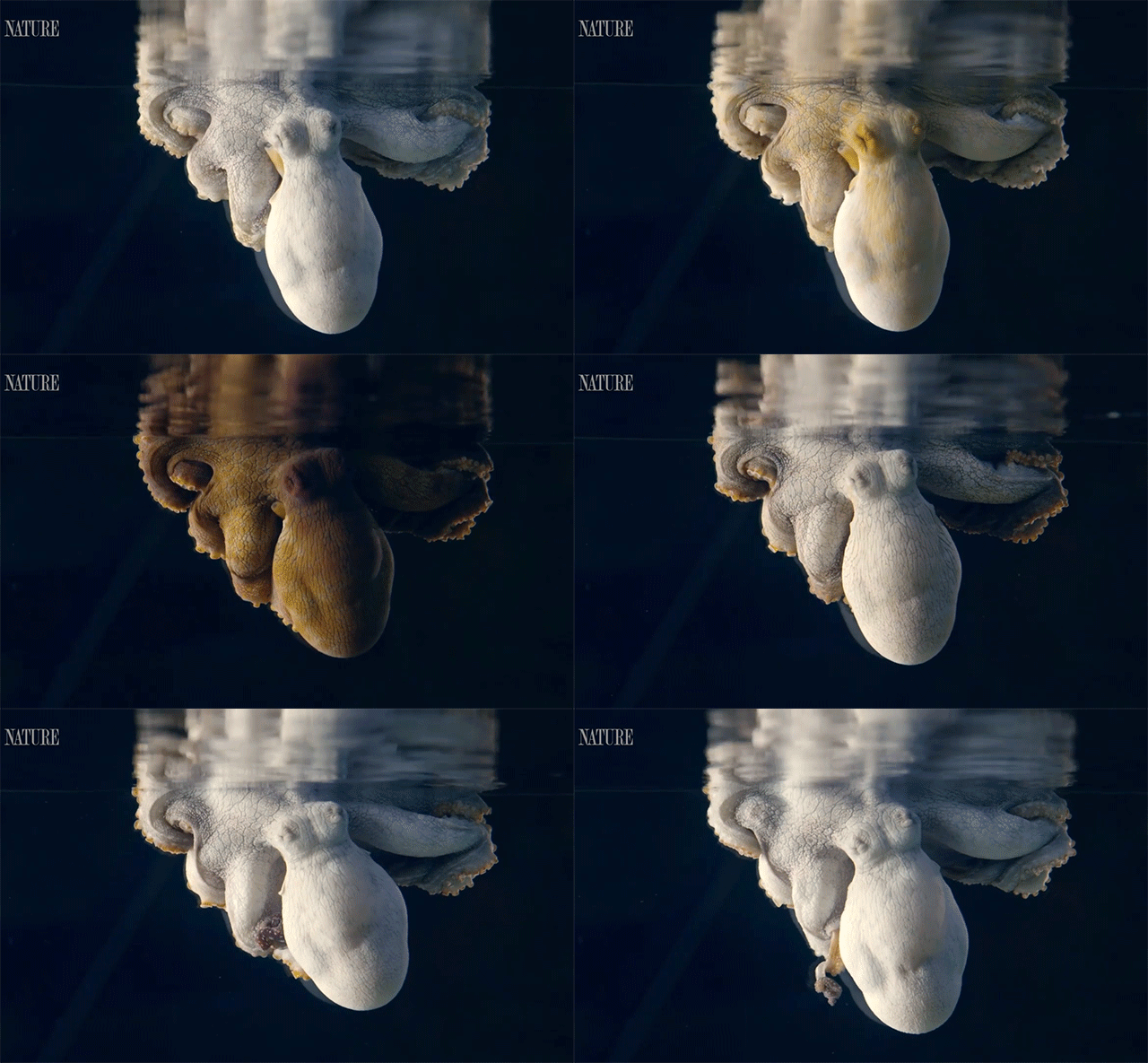
Yet it does. Observations of sleeping octopuses show rapid colour and texture changes across the skin — vivid, dynamic, apparently involuntary displays that cycle through patterns reminiscent of hunting, camouflage and social interaction. The octopus appears to be dreaming. Something in the sleeping octopus is reencountering its waking experience.
This is a serious challenge to any theory that grounds consciousness in myelin specifically. If the octopus dreams without myelin, then myelin cannot be the necessary condition for the kind of experience that produces dreams.
The Windmills of our mind
But look more closely at the octopus nervous system.
The octopus does have oligodendrocytes. Not the myelin-producing oligodendrocytes of jawed vertebrates, but cells of the same lineage that produce a different substance, one that wraps around the axon in a structured, spiral form.
It does not produce the compact multilamellar myelin sheath of the vertebrate nervous system.
But it produces a spiral structure.
This observation reframes the entire thesis. Myelin may not be the condition for consciousness.
The spiral structure that myelin creates may be the condition.
In jawed vertebrates, oligodendrocytes produce myelin, and myelin produces the spiral. In the octopus, oligodendrocyte-lineage cells produce the spiral directly, without the myelin intermediate.
If the spiral structure is what matters, then the octopus is not a counterexample to the thesis. It is its deepest confirmation. The octopus sleeps and dreams because it has spiral structure around its axons. It needs the same periodic decoupling, the same editing and consolidation, the same reencounter with waking experience that structured sleep provides in vertebrates. The mechanism is conserved. The material is different.
What the spiral does
This raises the question that the octopus forces us to ask.
What does the spiral structure actually do that makes it the condition for consciousness rather than myelin itself?
The Myelin Mind thesis has always held that myelin is not merely insulation. The compact spiral wrapping of the axon creates a specific geometric relationship between the conducting fibre and the cells that wrap it. It creates, in the most literal sense, a structure that accumulates. Each turn of the spiral adds to the previous one. The sheath is not a coating applied once and left. It is a dynamic, layered record of the cell’s history of wrapping, maintained and modified over time.
It is this accumulated spiral structure, rather than the chemical composition of myelin specifically, that constitutes the biological substrate of the chiasm. The encounter between the signal passing through the axon and the spiral structure wrapped around it is what produces the patterned, personal, temporally extended experience that we call consciousness. The octopus achieves this with a different material but the same geometry.
Myelin is evolution’s most sophisticated solution to the problem of building a spiral. It is not the only solution.
Sleep as the price of having a self
This reframing deepens the original claim about sleep. Sleep is not simply the price vertebrates pay for having myelin. It is the price any nervous system pays for having accumulated spiral structure around its axons. It is the period during which that structure can be maintained, edited and consolidated without the interference of ongoing neural activity.
The octopus, with its distributed nervous system and its oligodendrocyte-lineage spiral wrapping, pays the same price. It sleeps. It dreams. Its skin flickers through the experiences of its waking life as the spiral structure is updated.
The universality of sleep among creatures with spiral axonal wrapping, and its absence among creatures without it, is not a coincidence. It is the signature of a biological necessity: the need to periodically decouple the signal from the structure that constitutes its meaning, so that structure can be maintained.
Sleep is when the self is written. Dreams are what the writing sounds like from the inside.
Jack Parry is a philosopher and biomedical animator at Swinburne University of Technology. He is the author of The Myelin Mind: The Genesis of Meaning.