keywords: drugs hallucination myelin
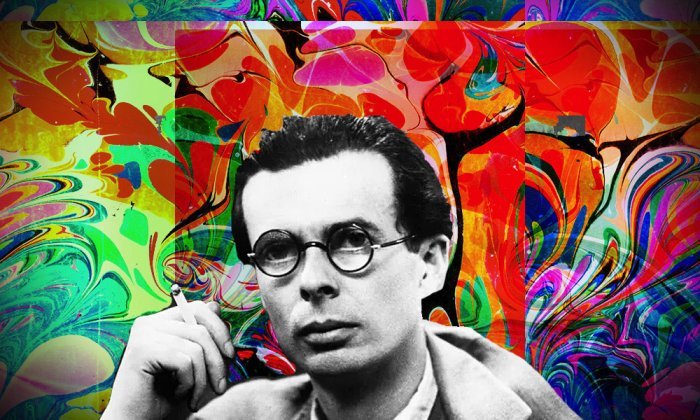
In 1953 Aldous Huxley took four tenths of a gram of mescaline in his Los Angeles home, sat down in his garden, and watched the flowers in a vase become inexhaustibly, overwhelmingly, almost unbearably present. He wrote about it in The Doors of Perception, one of the most precise phenomenological accounts of altered consciousness in the English language. The experience was ecstatic, coherent and, by his own account, completely manageable. He came back from it with his self intact and his curiosity enlarged.
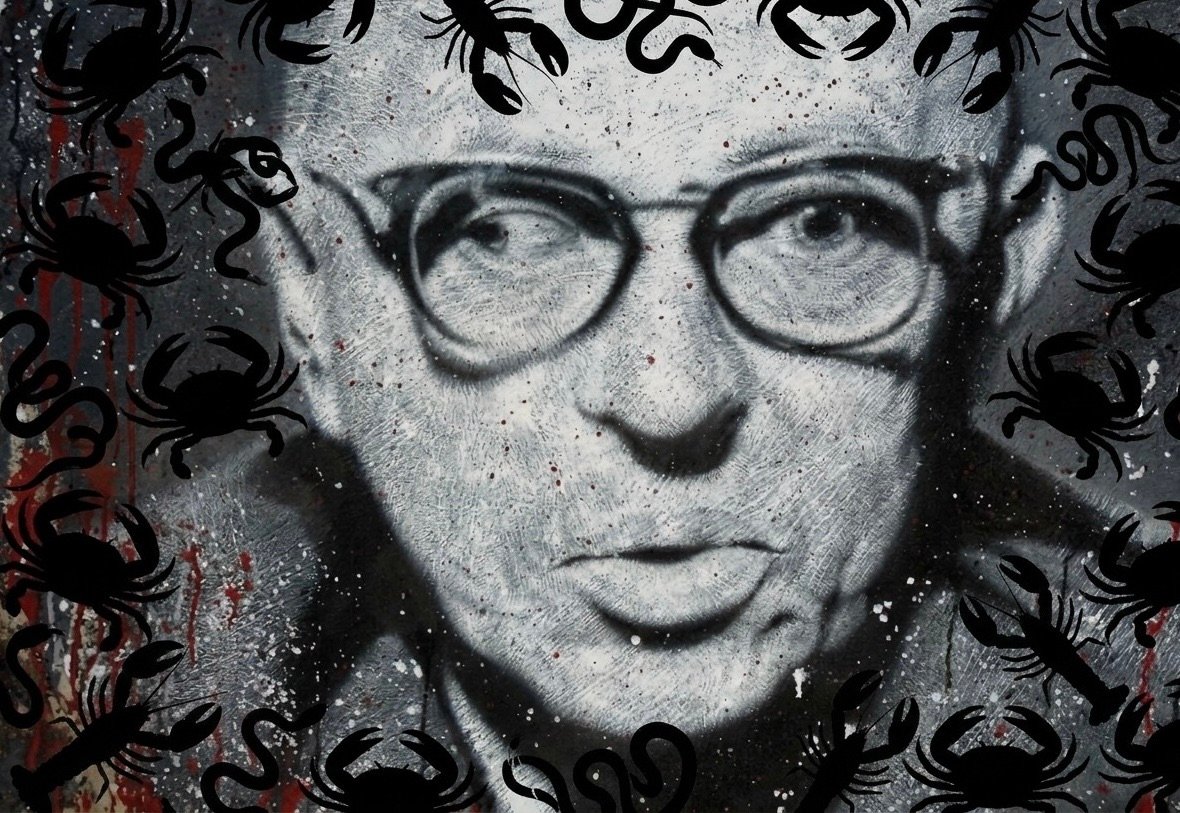
In January 1935 Jean-Paul Sartre took mescaline under medical supervision at Sainte-Anne Hospital in Paris, injected by his old school friend the psychiatrist Daniel Lagache, in the course of his researches into phenomenology. He was followed for months afterward by crabs. Not metaphorical crabs. Lobster-like creatures scuttling just beyond his field of vision, refusing to leave. Eventually he sought psychotherapeutic help from a young Jacques Lacan, which generated, in Sartre’s own words, “nothing that he or I valued very much.” With the crabs, they sort of concluded that it was fear of becoming alone. “The crabs really began when my adolescence ended,” he added, raising the question of whether they were entirely the product of a single mescaline injection. They made a cameo appearance years later in his play The Condemned of Altona, in which a race of monstrous crabs sits in judgment of future humanity.
Same drug. Radically different outcomes. And the difference was not in the mescaline.
Drugs: Uncoupled – unfiltered
Psychedelics, mescaline, LSD, psilocybin, and to a different degree MDMA and cannabis, work primarily by disrupting what the Myelin Mind calls selective uncoupling: the white matter’s capacity to filter which incoming signals couple with which accumulated conditions at any given moment.
In ordinary waking consciousness, the chiasm is editorial. Not everything that arrives through the senses couples with the full depth of the accumulated condition. The myelinated nervous system manages the encounter, permitting some couplings and suppressing others, maintaining the coherence of the self by ensuring that not everything is foreground simultaneously. You can sit in a room full of noise and read. You can walk through a city full of faces and attend to only one. You can feel grief without being consumed by every previous loss at once. This is selective uncoupling at work. It is not suppression. It is the architecture of a functional consciousness.
Psychedelics dismantle this architecture temporarily. The filter drops. Everything couples with everything. The accumulated condition becomes fully available to every incoming signal simultaneously, without the editorial management that white matter normally exercises over the encounter.
What happens next depends entirely on what is in the accumulated condition.
Huxley’s flowers
Huxley spent fifty years myelinating a nervous system around literature, philosophy, mysticism, perception and beauty. He had read everything. He had thought carefully about consciousness, about the relationship between the brain and experience, about the possibility that ordinary perception is a reduction of a much larger reality. His accumulated condition was, in the Myelin Mind’s precise sense, coherent and richly inscribed with wonder.
When the filter dropped, what flooded in was the accumulated condition of a mind deeply myelinated toward significance. The flowers in the vase became inexhaustibly meaningful because meaning was what Huxley had been accumulating his entire intellectual life. The experience felt like revelation because his white matter had been quietly preparing for exactly this kind of encounter for decades.
The drug did not produce the ecstasy. The drug removed the filter. Huxley’s accumulated condition produced the ecstasy.
Sartre’s crabs
Sartre’s accumulated condition was a different structure entirely.
In January 1935 he was thirty years old, deeply unhappy, and in the process of writing La Nausée, in which the protagonist is overwhelmed by the brute, meaningless, nauseating existence of a chestnut tree root. The root simply is, without reason, without justification, without the consolation of meaning. Roquentin, Sartre’s alter ego, cannot look at it without being flooded by a kind of existential vertigo, the feeling that existence itself is excessive, unjustified, fundamentally wrong.
This was not fiction. This was Sartre’s accumulated condition speaking. A mind myelinated around the absurdity of existence, around the body as contingent and nauseating, around the fundamental unjustifiability of being here at all.
When the filter dropped under mescaline, what surfaced was this. Sartre found it impossible to be a spectator of his own experience. He felt submerged against his will in a miasma of sensations, a world of grotesque extreme close-ups in which everything disgusted him. In his own unpublished self-observations, later quoted by Merleau-Ponty, he wrote: “Everything seemed at once clammy and scaly, like some of the large serpents I have seen uncoiling themselves at Berlin zoo. Then I was seized with the fear of being on a small island surrounded by serpents.”
The serpents came first. The crabs followed him home and stayed for months.
La Nausée, the novel he was writing at the time, is the mescaline trip as literature. The crabs are the chiasm without editorial control, and they were already there before the injection. Sartre said so himself: the crabs really began when his adolescence ended.
Sartre’s crabs were, in both the pharmacological and the epidemiological sense, a consequence of encounters conducted without adequate filtering. The Myelin Mind notes the convergence without further comment.
Merleau-Ponty’s correction
Ten years after Sartre’s session, the phenomenologist Maurice Merleau-Ponty took mescaline himself, in a dose much smaller than Sartre’s, and had a philosophically productive experience. He also quoted Sartre’s unpublished self-observations about the serpents, not to illustrate a bad trip but to make a precise philosophical point.
Hallucinations, Merleau-Ponty observed, pose a particular problem for the scientific method, which tries to explain them as events in a chain running from stimulus to state of consciousness, and thereby struggles to formulate their difference from reality. He offered an alternative account: “All hallucination bears initially on one’s own body,” as a physical product of the senses. A hallucination is presented to the observer alone. The normal person, he noted, “is genuinely concerned with being in the world.” The hallucinatory person has temporarily lost the coordinates of that concern.
This is the Myelin Mind argument stated without the biological mechanism. The hallucination is not a malfunction of perception. It is what happens when the accumulated condition of an embodied self loses its editorial connection to the incoming signal and surfaces in full. Sartre’s serpents and crabs were not visions produced by mescaline. They were the accumulated condition of Sartre’s embodied existence, the existential dread and the nausea and the adolescence that never quite ended, surfacing without the filter that normally kept them at the edge of perception.
Merleau-Ponty understood this because his accumulated condition was organised around precisely this question: the relationship between the body, perception, and the world. When his filter dropped, what surfaced was philosophy. When Sartre’s filter dropped, what surfaced was La Nausée.
The drug was the same. The accumulated conditions were not.
Benjamin’s Rausch
Eight months before Sartre’s session, in May 1934, the critic and philosopher Walter Benjamin was administered mescaline in Berlin by his friend the psychiatrist Fritz Fränkel. Benjamin had been thinking about intoxication for years, drawn to the German concept of Rausch, usually translated as intoxication but carrying deeper resonances: its underlying meaning of rush, roar, and thunder, and Nietzsche’s use of it to denote Dionysian ecstasy, the rending of the veil of appearances to reveal the primal life force.
Benjamin’s mescaline session produced elliptical notes almost indistinguishable from his sober jottings. He complained about the setting. He doodled repeated phrases in decorative shapes. He fixated on Nietzsche’s sister and her perversion of her brother’s archive. And then, repeatedly, he insisted he had discovered the secret of Struwwelpeter, the nightmarish German children’s book, but would not reveal it.
Finally he pronounced: “A child must get presents, or else he will die or break into pieces or fly away, like the children in Struwwelpeter. That is the secret of Struwwelpeter.”
This is the accumulated condition of Walter Benjamin speaking without a filter. A flaneur, a collector of fragments, a mind organised around the dialectic between immersion and detachment, between the gift and its withdrawal, between the Rausch of the city and the sobriety of the archive. His mescaline experience produced exactly what his accumulated condition contained: the anxiety of the child who does not know if the presents will come, the political dread of Berlin in 1934, and the insight that impertinence, his first reaction to the drug, is “the child’s chagrin at not being capable of magic.”
Benjamin’s accumulated condition was so thoroughly myelinated around that particular mode of attention that the drug could not shift it. It could only deepen it. The filter dropped and what surfaced was more Benjamin.
PTSD: when the myelination is the wound
Before we come to the therapeutic implications of all of this, we need to confront the darkest case: the accumulated condition that is not merely difficult or painful but structurally dominant, a myelination so intense and so rigid that it overwhelms every other accumulated condition the organism has built.
This is PTSD. And the Myelin Mind account of it is precise in a way that clinical psychiatry has not yet fully articulated.
Myelination normally happens slowly, through repetition, through the gradual inscription of experience into biological structure at the pace that metabolic demand can sustain. Skill acquisition, language learning, the slow accumulation of a professional identity: these are the ordinary rhythms of myelination, measured in months and years of productive struggle.
But myelination can also happen fast. Extremely fast. Under conditions of extreme metabolic demand, under conditions where the organism’s survival is at stake and the nervous system is flooded with every chemical signal it has for intensity and importance, a single encounter can inscribe itself into white matter with a force that years of ordinary experience cannot approach.
This is the biology of traumatic memory. The traumatic event does not merely happen and then recede into the past as accumulated condition, available but manageable, present but filtered. It myelinates so intensely, through a single encounter of catastrophic metabolic demand, that it becomes the dominant accumulated condition, the one that asserts itself over every other inscription the organism has built. It does not wait to be triggered. It is always already the condition from which every present encounter departs.
The soldier who flinches at a car backfire is not misremembering. His white matter is doing exactly what white matter always does: presenting the most deeply inscribed accumulated condition as the interpretive frame for every incoming signal. The backfire arrives as grey matter signal. The most powerfully myelinated accumulated condition couples with it immediately, before conscious evaluation, before voluntary control, before the slower editorial processes of the prefrontal cortex can intervene. He is not remembering the explosion. He is encountering it again, because in his white matter it never ended.
The flashback is not a failure of the past to stay in the past. It is the most deeply myelinated accumulated condition asserting its priority over every other encounter. The trauma is not too present in the sense of being insufficiently processed. It is too present in the literal biological sense: it is the most insistently coupled accumulated condition in the organism’s white matter, and it will remain so until something remyelinates the nervous system with sufficient intensity to build an accumulated condition that can match it.
This is why trauma is so resistant to purely cognitive intervention. You cannot think your way out of hypermyelination. The talking cure, to the extent that it works, works not by resolving the trauma intellectually but by slowly building, through the repeated encounter of the therapeutic relationship, a new accumulated condition of sufficient depth and coherence to provide an alternative to the traumatic one. The therapist’s consistent, warm, boundaried presence is the incoming signal. The slow trust that builds over months and years is the myelination. The therapeutic relationship is not the context for the healing. It is the biological mechanism of the healing.
PTSD is not a disorder of memory. It is a disorder of myelination. And this reframes not just the diagnosis but the entire therapeutic landscape.
The peyote road: what indigenous ceremony understood before neuroscience
Here is where the argument becomes both humbling and precise.
Long before Daniel Lagache injected Sartre with mescaline in a Paris hospital. Long before Aldous Huxley sat in his garden with his flowers. Long before any clinical trial, any pharmacological paper, any therapeutic protocol, indigenous communities across the Americas had developed ceremonial frameworks for the use of peyote that addressed, with extraordinary precision, exactly the problem the Myelin Mind identifies: how do you create the conditions for a productive encounter between a damaged accumulated condition and an incoming signal that can rewrite it?
The answer the Native American Church and its predecessors arrived at is not a drug protocol. It is a complete myelination architecture.
Consider what the peyote ceremony provides before the medicine is consumed. Weeks or months of preparation within a community that knows the individual, that holds their history, that has been myelinating its relationship with them over years. A ritual structure built from ancestral accumulated condition, songs and prayers and protocols inscribed over generations into the white matter of the community itself. A night-long container of fire and drumbeat and the presence of others who have made this journey and returned. A roadman, the ceremonial leader, whose accumulated condition is the most richly inscribed with the architecture of the ceremony, who has myelinated this role through decades of practice and sits at the centre of the fire as the signal that every other nervous system in the circle is encountering.
This is not set and setting in the folk sense. This is the systematic construction of an accumulated condition capacious enough to hold whatever surfaces when the filter drops. The ceremony is building the white matter container before the grey matter signal arrives.
And then the medicine comes.
For indigenous communities dealing with the trauma of colonisation, the dispossession of land and language and children, the alcoholism that followed as the organism’s attempt to decouple from an accumulated condition made unbearable by historical violence, the peyote ceremony addresses something that no hospital-administered session can address: the collective accumulated condition. The trauma of colonisation is not only individual. It is myelinated into the community as a shared accumulated condition, passed through generations not genetically but epigenetically and culturally, inscribed into every child who grows up inside a community that has been systematically dismantled. The healing must therefore be collective. A single individual cannot remyelinate in isolation from the community whose accumulated condition has shaped theirs.
The ceremonial circle is the biological mechanism of collective remyelination. Every nervous system in the circle is simultaneously contributing to the accumulated condition that holds the encounter and being held by it. The songs inscribe. The fire provides the incoming signal. The presence of others whose accumulated conditions carry both the wound and the having-survived-it creates the precise chiasmic conditions under which a new inscription becomes possible.
The outcomes data on sobriety rates in communities with strong ceremonial peyote practice is striking precisely because it confounds the individual pharmacological model. The drug alone does not produce the sobriety. Sartre’s crabs prove that the drug alone does not produce anything but what was already in the accumulated condition. What produces the sobriety is the systematic construction of a new accumulated condition through the ceremony, one that is richly enough inscribed with belonging, with ancestral continuity, with the felt presence of a community that has survived, to provide an alternative to the accumulated condition of trauma and disconnection that the alcoholism was managing.
This is not spirituality replacing pharmacology. This is pharmacology operating within the only biological architecture sophisticated enough to do what it needs to do: a community’s accumulated myelination holding the individual’s encounter with their own white matter.
The hospital injection is the pharmacology without the architecture. The peyote ceremony is the architecture understanding that the pharmacology cannot work without it.
The spectrum of substances
The logic extends across the pharmacological spectrum, but not uniformly. Each substance disrupts the chiasm differently, and the difference matters.
Mescaline and LSD act primarily on the serotonergic pathways that govern selective uncoupling. The filter drops and the accumulated condition surfaces in full. Duration matters: LSD lasts significantly longer than mescaline, which means more time for the accumulated condition to unfold, more time for both the ecstatic and the difficult material to complete their arc. The folk wisdom of set and setting is the Myelin Mind argument stated without the biological mechanism. Set is the accumulated condition. Setting is the incoming signal. The trip is the chiasm without editorial control.
Psilocybin is currently the most researched psychedelic in clinical settings and the literature is consistent: the quality of the experience correlates strongly with the patient’s psychological coherence before the session. Patients with unresolved trauma encounter that trauma. Patients with a stable and richly inscribed accumulated condition encounter that richness. The clinical teams who achieve the best therapeutic outcomes are the ones who spend the most time preparing the accumulated condition before the session, through careful conversation, through the building of trust, through the slow myelination of a therapeutic relationship that can hold what surfaces when the filter drops.
This is remyelination therapy without the name. The peyote ceremony understood it first.
MDMA is different in a precise and important way. It does not primarily disrupt selective uncoupling. It floods the nervous system with serotonin and oxytocin, temporarily shifting the emotional valence of all couplings toward safety, trust and connection. The accumulated condition is still present in full. But every encounter that surfaces does so in a context of radical felt safety rather than threat.
This is why MDMA-assisted therapy produces results in PTSD patients that no other intervention has achieved. The traumatic hypermyelination, the dominant accumulated condition that has been asserting its priority over every other encounter, can be approached without the threat response that normally accompanies it. The chiasm happens. The traumatic material surfaces. But the emotional context of the encounter is different, and a different context produces a different event. The session does not erase the traumatic myelination. Nothing can do that. But it creates the conditions under which new myelination can begin to build alongside it, and eventually to provide an alternative accumulated condition rich enough to offer the nervous system somewhere else to go.
The myelin is the same. The conditions of the encounter are changed. The chiasm produces something new.
Cannabis is the most individually variable of all the substances and the variability is the most precise evidence for the Myelin Mind account. The same dose, the same setting, produces paranoia in one person and deep relaxation in another, profound creativity in one mind and anxious blankness in another. Cannabis disrupts the timing of coupling rather than the filtering of it, slowing the chiasm, extending the duration of each encounter between incoming signal and accumulated condition. Whatever the white matter contains gets more time to surface. A mind inscribed with anxiety finds more anxiety. A mind inscribed with pleasure finds more pleasure.
The cannabis high is not a single experience. It is the accumulated condition of the person having it, experienced at a slightly different temporal register. And for the person whose accumulated condition carries unresolved trauma, cannabis is among the least safe substances available, not because of its pharmacology but because it slows the chiasm without dropping the filter, leaving the traumatic accumulated condition more present than usual without the containing architecture of ceremony or therapeutic relationship to hold the encounter.
Alcohol is the inverse of the peyote ceremony. It decouples the chiasm, temporarily separating the accumulated condition from the incoming signal, producing the felt sense of lightness and freedom that is the subjective experience of a self temporarily released from the weight of everything it has been. For a nervous system whose accumulated condition has been myelinated with trauma, this relief is not recreational. It is pharmacological self-management of an unbearable biological load.
The tragedy of alcoholism in traumatised communities is not moral weakness. It is the organism doing exactly what myelinated organisms do when the accumulated condition becomes incompatible with ordinary waking consciousness: finding a way to decouple from it. The peyote ceremony offers a different path to the same relief, but through encounter rather than decoupling, through the supported surfacing and collective holding of what is in the white matter rather than the temporary chemical suppression of its coupling with the incoming signal.
One path remyelinates. The other does not.
What the drug does not do
The drug does not produce the experience. The drug changes the conditions under which the accumulated condition encounters the incoming signal. The chiasm still happens. The self is still the product of that chiasm. But the editorial architecture that normally manages the encounter is temporarily suspended, and what surfaces is what was already there, waiting in the white matter, accumulated through everything the organism has lived.
This reframes the therapeutic question entirely. The primary question is not which drug to use, at what dose, for how long. The primary question is: what accumulated condition is this patient bringing to the encounter, and what architecture exists to hold the encounter when the filter drops?
A sound myelinated mind, coherent, richly inscribed, with a stable relationship to its own embodiment and its own history, encounters the unfiltered chiasm the way Huxley encountered his flowers. With wonder. With the feeling that what was always there has finally become visible.
A myelinated mind carrying unresolved trauma, rigidly inscribed patterns of threat response, a body schema that has been managing damage for years, encounters the unfiltered chiasm the way Sartre encountered his crabs. With dread. With the feeling that what was always lurking at the edge has finally arrived.
A myelinated mind so thoroughly inscribed with its own mode of attention that the drug cannot shift it encounters the unfiltered chiasm the way Benjamin encountered his Rausch. With more of itself. Deeper. The secret of Struwwelpeter surfacing at last.
And a myelinated mind held inside a ceremonial architecture of collective accumulated condition, inscribed with ancestral continuity and community presence and the knowledge that this encounter has been made before and survived, encounters the unfiltered chiasm the way the peyote road was designed to be encountered: with the whole community as the accumulated condition, holding the individual’s encounter with their own white matter until something new can be inscribed.
The drug did not make any of these experiences. The accumulated condition made all of them. The drug just removed the filter long enough for each mind to see what it had been living with all along.
Huxley prepared for his mescaline experience his entire intellectual life. His accumulated condition was ready for the encounter. The flowers were waiting in the white matter long before he took the drug.
Sartre was not prepared. His accumulated condition was in the middle of producing La Nausée. The crabs were already there.
Benjamin was constitutionally incapable of being unprepared. His accumulated condition turned everything into an archive. Even the Rausch became a jotting.
And the roadman sitting at the centre of the fire had been preparing his entire community for generations. The medicine arrived into an accumulated condition that had been building since before anyone in the circle was born.
That is the difference between a drug and a ceremony. Not the pharmacology. The myelination.
Jack Parry is a philosopher, polyglot and biomedical animator at Swinburne University of Technology. He is the author of The Myelin Mind: The Genesis of Meaning.