keywords: myelin waking up consciousness
When we wake up, it is not like a lamp being switched on. We feel groggy, confused, slow, clumsy. Feeling sleepy is the horizon of consciousness, but the horizon is hazy and covered with clouds. It takes time to wake up. Some reach for coffee, the military sounds bugles, an effective alarm clock is generally loud and annoying. To cross the bridge from the unconsciousness of sleep to the awareness of wakefulness is often unpleasant and slow if we aren’t ready. We all know how this feels: we experience it every day of our lives. But what does that look like inside the mind? The wired mind doctrine insists that wakefulness just looks like electrical activity buzzing through the circuits of the brain-as-processor. But if my computer took as long as I do to boot up, it would be terrible design. Who would buy it? I have often thought about this through the Myelin Mind lens, that consciousness happens when neural flows couple with the structures of myelin. But I never thought it could be watched. Douglas Fields was the first person in history to watch a mind waking up.
In 2009, the neuroscientist R. Douglas Fields published a book called The Other Brain, a sustained argument that the glial cells surrounding and insulating our neurons were not the silent, passive support staff they had been assumed to be for most of the history of neuroscience, but active, metabolically alive participants in the life of the mind. The title was itself a provocation. There was another brain, Fields was saying, one we had been ignoring, and it had been doing things under our noses the entire time.
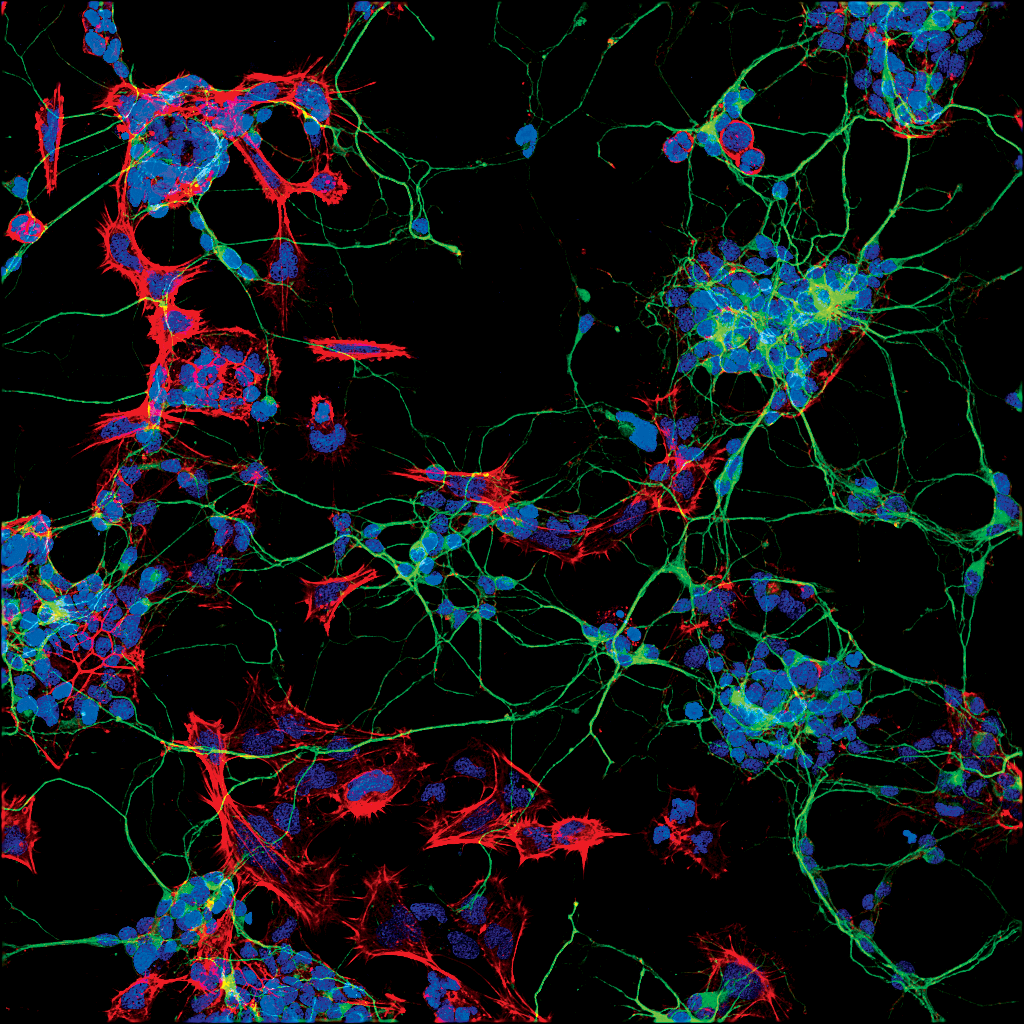
In the course of that work, Fields described an experiment that I have been thinking about ever since. His team had taken Schwann cells, the glial cells that wrap peripheral axons in myelin, and tagged them with a fluorescent marker. They then stimulated the axon that each Schwann cell was wrapping. What they observed was this: the Schwann cell began, gradually, to illuminate. Not instantly, not all at once, but stage by stage, spreading through the cell as metabolic activity increased, until it was as bright and as metabolically active as the neuron it had been assigned to serve. It woke up. It woke up at a measurable speed. And the speed, Fields noted, was the speed of waking.
Read that again. Not “comparable to” the speed of waking. Not “reminiscent of.” The speed of waking. The same speed. The same process, observed once from a laboratory bench and once from inside a human skull, and they are the same event.
This is the moment I want to stay with, because I think its significance has not yet been fully understood.
Two descriptions of the same thing
For as long as we have had neuroscience, we have had a working assumption so deeply embedded it rarely needs to be stated: that the first-person experience of consciousness is one thing, and the third-person description of neural activity is another thing, and that the relationship between them is the problem of consciousness, perhaps the hardest problem there is. The gap between the description and the experience, between the firing of neurons and the sensation of firing, between the map and the territory, is the place where philosophy and neuroscience come to a standstill and stare at each other across an apparently unbridgeable distance.
Fields’ observation suggests that we have been looking in the wrong place. The gap, if there is one, is not between neural activity and experience. It is between neural activity and the encounter of neural activity with its own accumulated condition.
What the fluorescent Schwann cell reveals is not a neuron doing its job. It reveals white matter responding to grey matter. It reveals the insulating, myelinated condition of the organism waking to the signal that is arriving through the senses. And what the first person experiences on waking is not, as we are often told, the brain “coming back online,” as though consciousness were a computer rebooting. It is this: the accumulated myelinated structure of the self re-encountering the world.
The feeling is not incidental. It is not a byproduct of the real event happening somewhere in the neurons. The feeling is the event, observed from the inside.
The chiasm
The Myelin Mind develops a single central argument: that consciousness arises not from neural activity alone, not from white matter alone, but from the encounter between them. I call this encounter the chiasm, borrowing the term from the philosopher Maurice Merleau-Ponty, who used it to describe the reversible relation between the touching and the touched, the seeing and the seen, the moment where self and world are neither identical nor separate but folded into each other at the site of experience.
In biological terms: grey matter is the world arriving through the senses, the present signal, the incoming flow. White matter is the accumulated condition of experience, the myelinated history of every previous encounter, the biological record of how this organism has moved through the world. The chiasm is the meeting place. Consciousness arises there, at that encounter, and nowhere else.
Fields saw the chiasm forming. He saw grey matter, the electrically active axon, calling out to white matter, the Schwann cell beginning to illuminate, and what he recorded as a curve on a graph is, from the inside, the experience of coming to.
This is not a metaphor. I want to be precise about this. The claim is not that the waking Schwann cell is like the feeling of waking up, in the way that a sunrise is like hope, or the way that a neural network is said to be like a brain. The claim is that these are two descriptions of the same event, one made with instruments, one made with experience, and the event is the formation of the chiasm between white matter and grey matter. Fields described it from outside. You have felt it from inside. Neither description is more real than the other, and neither is complete without the other.
The reverse: what it feels like to pass out
If the argument is correct, it should also run in the other direction. If waking is the gradual illumination of white matter in response to grey, then unconsciousness should be its systematic dimming, and the experience of passing out, the stages of anaesthesia, the progressive withdrawal of alcohol into the deepest and most primitive structures, should feel like the lights going off in a particular order, the most recently acquired going first, the most ancient and deeply inscribed going last.
And this is precisely what it feels like.
The sequence is well known. Under anaesthesia, under deep intoxication, moving toward unconsciousness, the first things to go are the highest cortical functions: the subtle social judgment, the capacity for self-monitoring, the fine modulation of language. Then language itself begins to slur. Then coordination fails. Then the ability to stand. Then, somewhere close to the end of the sequence, something shifts that is harder to name, a quality of presence, a thickness of self, and then there is nothing until the ceiling again.
What we are observing, from the first person, is the reverse of what Fields observed from the third. The chiasm is closing. White matter is dimming, stage by stage, in the reverse order of its own developmental history, the most sophisticated and recently myelinated first, the most ancient and deeply inscribed last. The self is not simply being switched off. It is being unpeeled, layer by layer, in evolutionary reverse. The person who emerges at the bottom of that sequence is not a degraded version of the waking self. They are a temporally earlier version, operating with the myelinated structures that were in place before the recent ones arrived.
This is why the drunk person feels, in some registers, like an authentic self. The recent constructions, the manners, the careful judgments, the self-editing have gone quiet. What remains is older, more insistent, and in its own way more honest. It is not the real self. It is an earlier self, still intact, still myelinated, still there.
What the wired mind cannot say
The dominant account of consciousness, what I call the wired mind, locates experience in the neuron. In its most sophisticated contemporary form, it proposes that consciousness is an emergent property of sufficiently complex neural computation: given enough firing, in the right patterns, at the right frequencies, experience arises. On this account, waking is the resumption of neural activity, and sleep is its suspension.
This account has a problem with Fields’ observation. If consciousness is neural firing, and if Schwann cells are not neurons, then the gradual illumination of the Schwann cell is irrelevant to the story of waking. It is a support mechanism, a metabolic housekeeping detail, interesting to cell biologists but of no philosophical significance. The speed at which it illuminates, the fact that the speed matches the phenomenology of waking, is a coincidence, not a discovery.
But the coincidence is too precise to be a coincidence. And the architecture of the process, the fact that it is the insulating, myelinated cell that illuminates in response to the axon’s activity, and not simply the axon that continues in a new state, and the fact that the illumination is gradual, and staged, and that its speed matches not some approximate average of waking but the felt temporal structure of waking from the inside: all of this points toward a different conclusion.
What is waking? Waking is the re-engagement of the accumulated myelinated condition with the incoming signal. It is not one thing switching on. It is two things finding each other again after the periodic decoupling we call sleep, during which the white matter has been editing, consolidating, and updating the accumulated condition without the interference of incoming neural flow. The chiasm opens. The self reconstitutes itself at the encounter. And the process, from the inside, feels like coming on, because from the outside, measured in fluorescent light, it looks like coming on.
The wired mind has no explanation for why the speed should match. The Myelin Mind has nothing else.
What Fields saw
I want to return to Fields’ experiment for a moment, because I think there is something in his language that has not been given enough attention.
When he described the Schwann cell illuminating at the speed of waking, he was not reaching for a metaphor. He was a scientist describing a measured quantity. The speed of waking is a real variable. It can be clocked. It has a characteristic duration, a characteristic staging, a characteristic feel that is recognisable to anyone who has ever been conscious and then not conscious and then conscious again, which is to say everyone. He was noting that the speed of this cellular process matched the speed of that phenomenological process, and he let the observation stand without fully drawing out its implications.
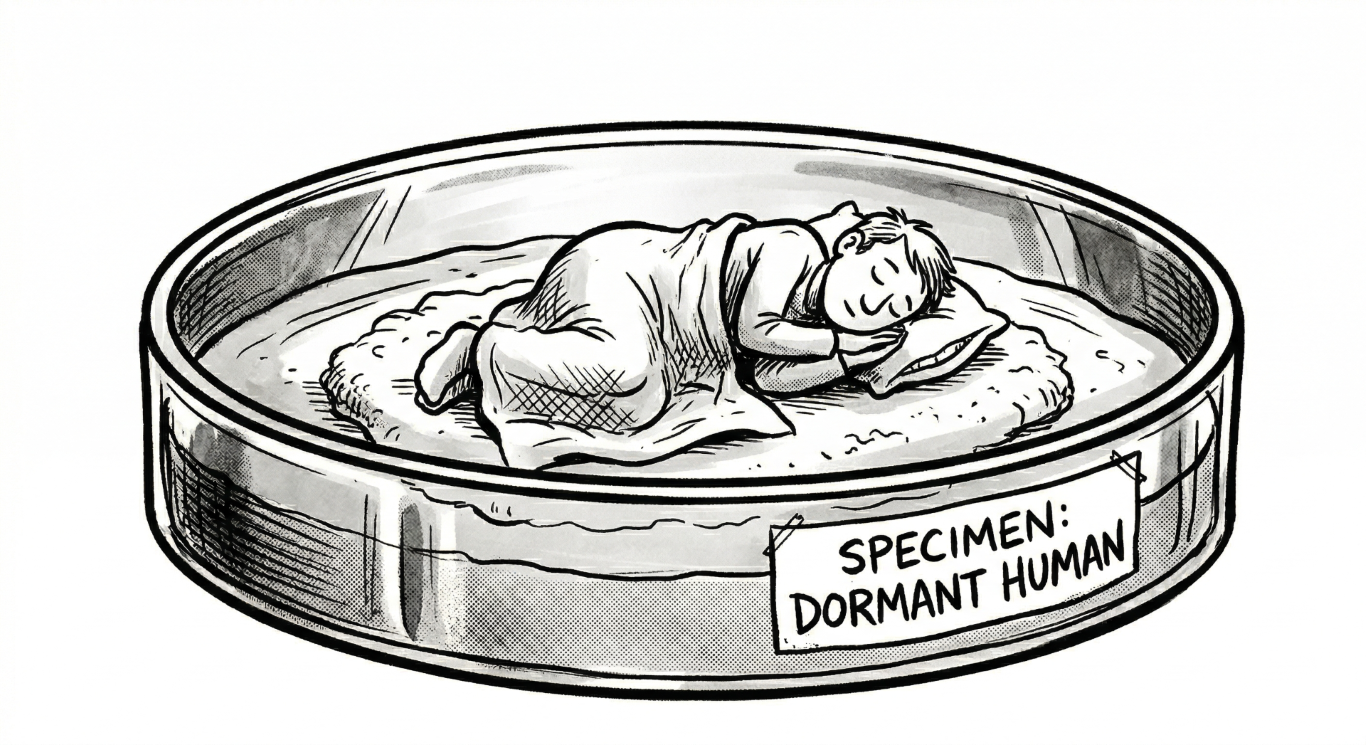
The implication is this: what you experience as waking is what Fields measured. The gradient of illumination in the petri dish is the gradient of gathering selfhood that you felt this morning. You were on one side of the glass. Fields was on the other side. You were both watching the chiasm form.
This is, to my knowledge, the first experimental observation of the formation of the chiasm. It was made in peripheral nervous tissue, in Schwann cells rather than the oligodendrocytes that myelinate the central nervous system, and there is more work to be done in extending the finding to the white matter of the brain itself. But the principle is there, visible, measurable, and confirmed by the oldest and most reliable instrument available to science: the first-person experience of every person who has ever woken up.
The cell that illuminates at the speed of waking is not waking. It is participating in the formation of the very encounter in which waking consists. It is white matter meeting grey matter. It is the accumulated condition of experience opening to the world again.
It looks like a cell coming on in a dish. It feels like you.
Jack Parry is a philosopher, polyglot and biomedical animator at Swinburne University of Technology. He is the author of The Myelin Mind: The Genesis of Meaning.