keywords: Myelin Language Method
There is a theory, stated with great confidence in most introductions to linguistics, that after the age of twelve or so, the window for language acquisition closes. The brain, the story goes, has hardened. The critical period has passed. You can still learn a language after childhood, the theory concedes, but you will never acquire one. You will always be translating, always be reaching, and your accent will give you away every time.
I speak nine languages. I learned eight of them after the age of twenty-three. And I have no detectable accent in any of them. French people ask me which part of France I am from. I tell them the south. The Australian part.
Either I have a very unusual brain, or the theory is seriously flawed. I have spent a great deal of time thinking about which of these is true, and I have come to believe it is the latter. The critical period theory is measuring something real, but it is misidentifying what it measures. It is not measuring the closing of a window. It is measuring the consequences of the wrong method.
What accent actually is
Before we can talk about language acquisition, we need to talk about accent, because accent is where the standard theory reveals its assumptions most clearly.
An accent is not a memory failure. It is not the result of forgetting to pronounce things correctly, or of insufficient vocabulary, or of imperfect grammatical knowledge. You can have flawless grammar, an enormous vocabulary, and a strong accent. The accent lives somewhere else entirely. It lives in the mouth, the jaw, the larynx, the breathing. It lives in the deeply inscribed motor patterns of the first language, patterns that were not learned but lived, myelinated so thoroughly in infancy and childhood that they have become the body’s default. When a second language arrives, it sits on top of those patterns. The mouth still belongs to the first language. The new words are processed through an existing myelinated structure that was built for different sounds, and the friction between the new signal and the old structure is what we hear as an accent.
This is not a deficiency. It is the predictable consequence of a particular acquisition history. The first language was inscribed. The second was learned. Inscription and learning are not the same process, and they do not produce the same result.
The Myelin Mind argument is that consciousness, memory, habit and skill do not live in the neurons. They live in the white matter, the myelinated sheaths that wrap the axons and determine the speed, efficiency and automaticity of neural transmission. What we call skill, in any domain, is a myelinated pathway. What we call habit is a myelinated pathway. What we call mother tongue is a set of myelinated pathways so thoroughly inscribed that they are no longer experienced as language at all. They are experienced as thought itself.
An accent is the sound of a language that was shoehorned rather than inscribed. It is the sound of white matter that belongs to somewhere else.
The pool
Here is the method that works, stated as plainly as I can manage, because it is not comfortable.
To acquire a language, you must be thrown into it. Not introduced to it, not enrolled in it, not given a textbook and a vocabulary list and a patient teacher.
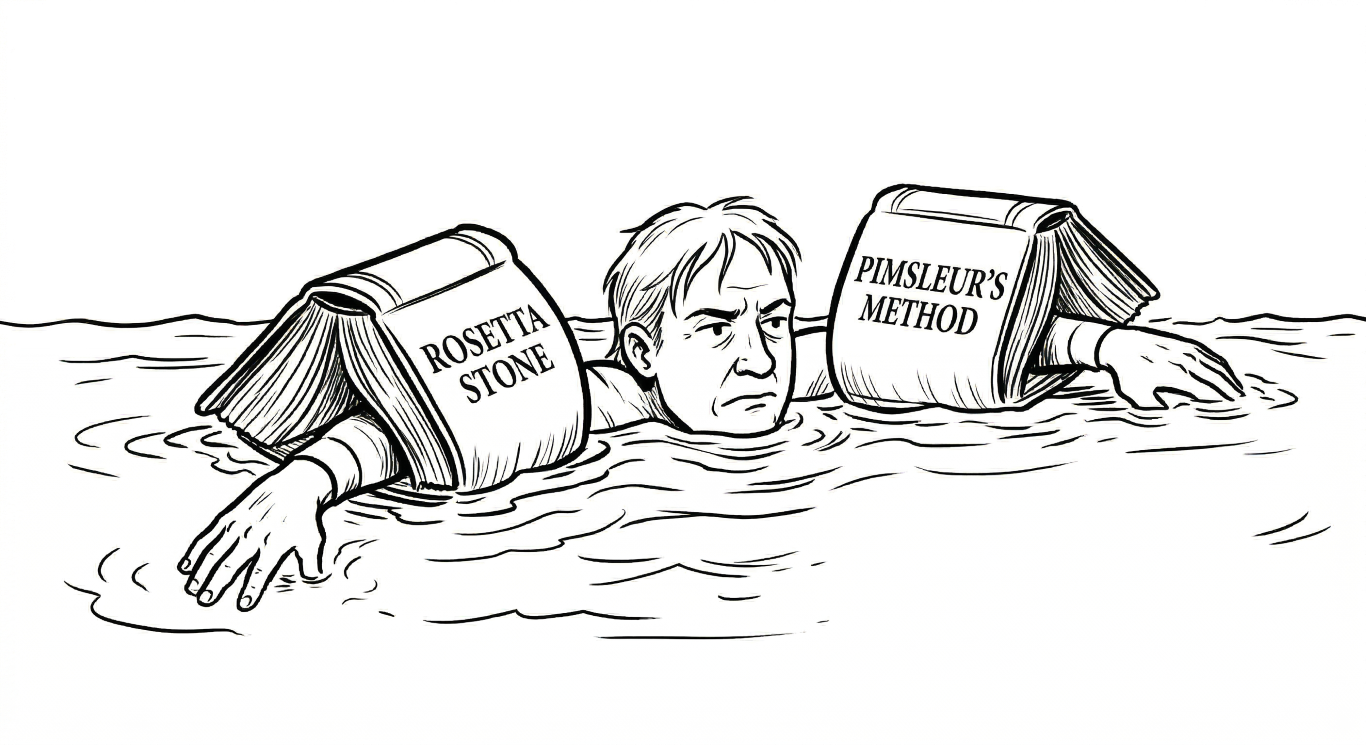
Thrown. As in: no alternative. As in: the deep end of the pool, and sinking is not optional (unless you are the German coast guard).

This sounds cruel when applied to children, and it is not a recommendation for cruelty. But it is a description of exactly what happens to every child who acquires a first language, and it is the only honest account of what works for adults too. The child does not learn to speak. The child speaks because it has no other way to be in the world. Language is not a subject. It is the medium of existence. Every word is connected to something that matters: warmth, food, presence, absence, fear, comfort. The intentional arc, the reach from inner state to outer act, is completed through language from the very beginning, and the completion of that arc is what drives inscription.
Heidegger called the fundamental condition of human existence thrownness. We do not choose to be born. We do not choose our language, our culture, our body, our historical moment. We are thrown into a world already underway, with no instruction manual and no edge of the pool to cling to. And it is precisely this condition, the condition of no alternative, that makes first language acquisition universal and effortless. Every child acquires the language of their world, not because children are gifted linguists, but because they are thrown, and language is the only way to swim.
Adults learning a second language are almost never thrown. They have floaties. They have the first language to retreat into, a teacher to slow things down, a classroom where failure has no real consequence. They cling to the edge of the pool and kick their legs and call it learning. And they are learning, in a sense. But they are not inscribing. The pathway stays thin, dependent on the prop, never automatic. The moment they stop practising, it begins to fade. Nothing was laid down. Nothing became them.
Rote learning fails for precisely this reason. So does passive reading, so does vocabulary drilling, so does grammar study in isolation. These techniques produce knowledge about a language. They do not produce inscription into one. The distinction is everything.
What the struggle actually does
The Myelin Mind framework offers a precise biological account of why struggle works and comfort fails.
When a neural pathway is activated under conditions of effort, necessity and meaning, the metabolic demand on the surrounding tissue increases sharply. Astrocytes, the star-shaped glial cells that support and supply the neurons, respond by shuttling lactate to the active axons. Lactate is both the fuel for intense neural activity and the signal that recruits oligodendrocytes, the myelin-producing cells of the central nervous system. The oligodendrocyte wraps the axon, lays down myelin, and the pathway becomes faster, more efficient, more automatic. What was effortful becomes fluent. What was retrieved becomes spoken. What was learned becomes you.
This is the biology of the deep end. The struggle is not incidental to acquisition. The struggle is the lactate signal. The necessity is what drives oligodendrocyte recruitment. A language practised in the absence of real consequence never generates enough metabolic demand to trigger the process. A language lived at the level of survival generates nothing else.
But struggle alone is not sufficient. And this is the point that most immersion theories miss.
The repetition must be meaningful. A word or phrase repeated in a void, disconnected from purpose, from consequence, from the texture of actual life, has nothing to connect to. You are nailing planks together with no bridge to build. The oligodendrocyte responds not simply to activation but to activation in the service of something. Meaning is not the reward at the end of the process. Meaning is the condition for the process to begin. You must see both sides of the bridge before you can build it.
The scaffold and the structure
I have been developing my own approach to adult language acquisition, and I want to describe it in some detail, because I think it illustrates the biological argument more precisely than any abstract account could.
Hebrew is a radically different language from anything in the Indo-European family. For an English speaker, there are no familiar handholds, no cognates, no shared grammatical logic. It is, in the terms of the spinal cord injury analogy I use elsewhere in this book, a case of no connections. The axons have nowhere to go. There is no existing myelinated structure for the new signal to couple with.
The first task, then, is not to learn Hebrew. It is to build the first fragile bridge between an incoming Hebrew signal and an existing myelinated structure. I call this the seed.
“Ani lo yodea” means “I don’t know” in Hebrew. To an English-speaking ear, “lo yodea” sounds remarkably like “no idea.” That resemblance is the seed. It is not a mnemonic in the conventional sense, not a memory trick to be deployed and then discarded. It is the first point of contact between a new signal and an existing myelinated structure, the first moment at which the incoming Hebrew has somewhere to land. From that contact, a pathway can begin to form.
But the seed is only the beginning, and its biological role is precisely analogous to the astrocyte scaffold in tissue repair after injury. The astrocyte does not rebuild the pathway. It provides a temporary medium, a biological bridging structure, that holds the space open long enough for the real repair to begin. Once the oligodendrocytes arrive and the myelin is laid, the scaffold is no longer needed. It is reabsorbed. The pathway stands on its own.
This is what happens with the seed. I use “ani lo yodea” immediately, in real conversation, in real context, completing the intentional arc from thought to utterance. I use it again and again, not as repetition in a void but as genuine communication, each instance embedded in a situation where not knowing something actually matters. The massive meaningful repetition in context is the remyelination. The pathway thickens. The speed increases. And at some point, which I can feel but cannot precisely locate, I no longer need the seed. I no longer hear “no idea” when I say “lo yodea.” The Hebrew phrase has become its own structure, inscribed, automatic, mine. The astrocyte did its job and retired.
The same process occurred years ago with French. “Toile d’araignée” is the French word for spiderweb. It is phonetically challenging for an English speaker and entirely without obvious English cognate. The seed in this case was a felt sonic resemblance, private and somewhat absurd, that I used only long enough to get the word into circulation. Once it was in circulation, once it had been used enough times in enough real contexts, the seed dissolved. The word is now simply the word for spiderweb, in my mouth, with whatever accent the south of Australia has contributed to the French of the Midi.
Why you don’t forget
There is one more thing that distinguishes inscription from learning, and it is the thing I find most telling about the nature of language as a myelinated phenomenon.
I do not forget my languages. Not the four I speak fluently, not the one I communicate in, not even the receptive competence in Portuguese that arrived, I suspect, as a consequence of deep fluency in Spanish and French rather than any deliberate effort. This is not because I have an exceptional memory. I do not. It is because memory is not where any of this lives.
A language that has been inscribed into white matter is not stored. It is not filed away in a retrieval system, waiting to be accessed when needed and subject to decay when not. It is part of the myelinated structure of the organism. It is not something I know. It is something I am. You do not forget how to walk because walking is not in your memory. You do not forget your mother tongue because your mother tongue is not in your memory either. It is in your white matter, which is to say it is in the accumulated condition of your experience, which is to say it is you.
People who lose a language, who find that years of disuse have eroded what was once fluency, lost it at the level of learning, not inscription. The pathway was never fully myelinated. The floaties were always doing more work than it appeared. When the floaties were removed, there was less there than anyone had thought.
This is also why the gradient of my own languages is informative rather than embarrassing. Four languages are fully inscribed: they are me. One, Italian, is communicable: the pathway is there but not yet fully myelinated, functional under pressure, unreliable under fatigue. Portuguese I understand but do not yet speak: the receptive pathway has myelinated through proximity to Spanish and French, but the expressive pathway is still forming. Hebrew, Japanese and Mandarin are in progress: the seeds are planted, the first bridges are under construction, the astrocyte scaffolds are in place. The oligodendrocytes are being recruited. The work is underway.
The critical period, reconsidered
What, then, is the critical period actually measuring?
It is measuring the consequences of thrownness. The infant has no alternative. The language of the world it is born into is the only available medium for every need, every relationship, every act of being. The lactate signal is constant and overwhelming. The myelination is total. The language becomes the organism.
As we age, we acquire alternatives. We develop the first language to the point where it can serve every purpose. We build a self that is already inscribed, already structured, already complete in the sense that it no longer needs a new language to survive. And so the conditions for inscription become harder to recreate. Not impossible, but harder. The pool is still there. But we have learned, over years of successful swimming, that we can stay in the shallow end. The deep end requires a choice that the infant never had to make.
The critical period closes not because the brain hardens, but because the necessity softens. The window is not biological. It is existential. And it can be reopened, deliberately, by anyone willing to take the floaties off and mean it.
A first language is not learned. It is lived. And a second language, acquired properly, at the level of necessity and meaning and struggle and inscription, is lived too. It does not sit alongside the self as an acquired skill. It becomes part of the accumulated myelinated condition of who you are.
You don’t remember it. You are it.
Jack Parry is a philosopher, polyglot and biomedical animator at Swinburne University of Technology. He is the author of The Myelin Mind: The Genesis of Meaning.