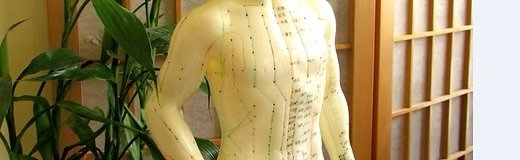
Every two weeks Dr. Lee puts needles into my body and twists them. Not stabs. Twists. The distinction matters more than it sounds.
When the needle rotates at the right point, something runs. Not pain, not quite sensation in the ordinary sense, but a flow, a thread of something moving along a path that feels as though it was already there, waiting. Traditional Chinese medicine calls this de qi, the arrival of energy. For five thousand years practitioners have sought this sensation as confirmation that the needle has found what it was looking for. Western medicine has spent decades trying to explain what that something is, and has been almost right so many times that the almost begins to look like a clue.
This article follows that clue.

The Problem with Meridians
Chinese medicine maps the body through twelve principal meridians, channels through which chi, the body’s vital energy, flows in circuits connecting surface to organ, limb to viscera, the periphery of experience to its depths. When these channels flow cleanly the body maintains itself. When they become blocked, through stress, illness, injury, or the slow accumulation of a life poorly attended to, the flow falters and pathology follows.
Western medicine has never been comfortable with this map. Not because it has disproven it, but because it cannot find it. Decades of anatomical investigation have failed to identify a distinct meridian structure. The channels do not correspond to veins, arteries, lymphatics, or nerve trunks in any clean way. The conclusion drawn by many western practitioners is that meridians do not exist as anatomical structures, that they are a functional or metaphorical description of something the body does rather than something it has.
This conclusion may be looking in precisely the wrong place with precisely the wrong instrument.
Weigert-Pal Staining
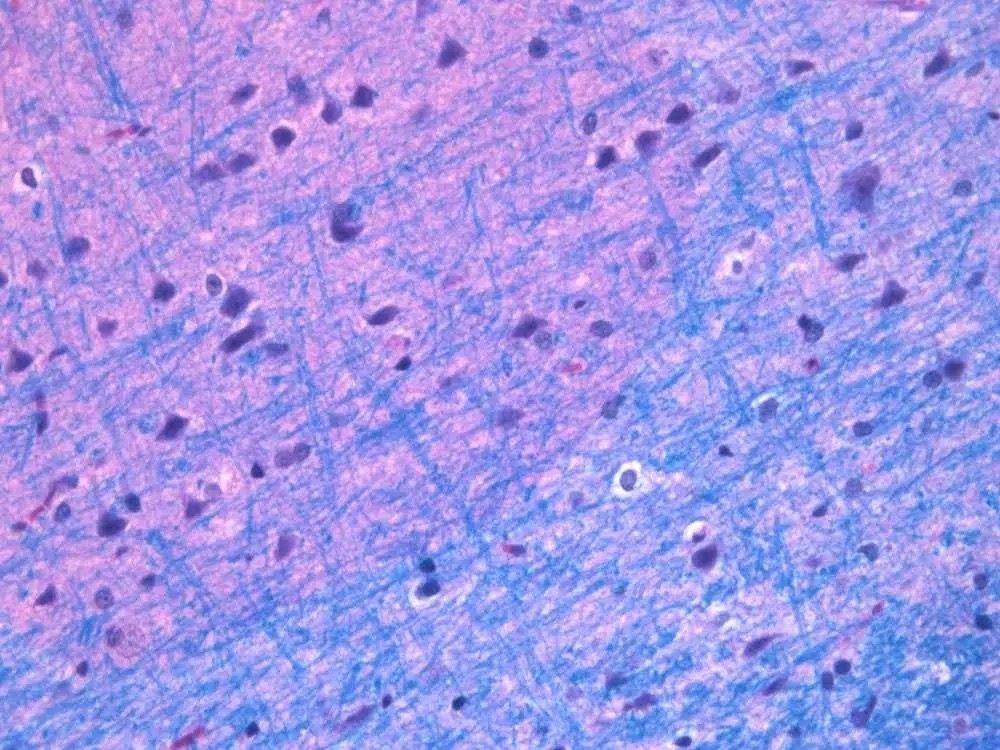
The nervous system can be stained in several ways. The Cajal and Golgi methods, the classical tools of neuroanatomy, reveal individual neurons, their dendrites, their axonal projections. These are the methods that built the standard map of the nervous system. They show you where the signal travels.
The Weigert-Pal method does something different. It stains myelin specifically, the accumulated myelinated sheath that wraps axons not as insulation but as the inscribed biological record of everything the nervous system has learned, encountered, and survived. When researchers apply the Weigert-Pal stain to peripheral nervous tissue, a reticular network appears, a distributed, branching, rhizomic structure that the signal-focused stains do not reveal.
This network corresponds closely to the TCM description of the meridian system.
The meridians are invisible to the tools that look for signal. They appear only when you look for the accumulated condition. This is not a coincidence. It is a clue about what meridians actually are.
The Chiasmic Node
There is a further finding that sharpens the picture. The principal acupuncture points do not sit on nerve trunks. They sit at the interfaces between nerve branches, the meeting points of anterior and lateral cutaneous nerves, the junctions where one myelinated pathway encounters another.
In Myelin Mind terms, these are chiasmic nodes. Points where two accumulated myelinated conditions meet. Where the encounter between different inscribed histories of the nervous system produces something neither pathway generates alone.
The needle does not target the signal. It targets the meeting point. The twist activates the chiasm.
The Polluted River
A healthy meridian, in this reading, is a clean channel. The accumulated myelinated condition of the PNS flows through its rhizomic network, chiasmic nodes completing their encounters, the body’s inscribed history meeting itself productively at every junction. Chi is not a mystical energy separate from biology. It is chiasmic flow through the myelinated rhizome. The sensation of the body knowing itself from the inside.
When the body is stressed, chronically inflamed, poorly slept, habitually contracted around old injuries or unresolved losses, the accumulated condition becomes compromised. Not at the level of signal, the axons still fire, the neurons still transmit, but at the level of the inscribed condition that the signal must pass through. The chiasmic nodes become noisy, rigid, unable to complete their encounters cleanly. The river does not stop. It becomes choked with debris, and the water, still moving, can no longer find its course.
This is what acupuncture addresses. Not the signal. The condition the signal is meeting.
The Resonant Twist
Here the argument becomes speculative, offered as hypothesis rather than established mechanism, though the eidetic instinct behind it points somewhere the biology may eventually confirm.
The myelin sheath is not a passive wrapping. It is a spiral structure, laid down in concentric layers by Schwann cells in the peripheral nervous system, each layer inscribed through encounter and consolidated through sleep. As the twitching axon article on this site has explored, the axonal membrane is mechanically active. It swells and contracts with each action potential, releasing ATP through volume-sensitive channels, and the myelinating Schwann cell listens to what the axon is doing and responds to what it hears.
If myelin has mechanical resonant properties, and the geometry of the spiral suggests it does, then rotation is not an arbitrary clinical refinement. It is the practitioner finding the resonant frequency of the accumulated myelinated structure at the chiasmic node. A straight insertion compresses. A rotation engages the spiral along its own geometry, the way you tune a string by turning the peg rather than pulling it.
The needle, relative to the myelinated fibers it is perturbing, is something between an obelisk and a continent descending into a world of whispers. It does not manipulate individual sheaths. What it produces is a disturbance, a mechanical wave propagating through the accumulated condition of the PNS, finding the blocked chiasmic node, shifting what has compacted there.
The de qi flow is not the needle sending a message. It is the river remembering it had a course.
Five Thousand Years of Phenomenological Attention
Chinese medicine did not find the meridian system through anatomical dissection. It found it through something harder and in some ways more rigorous: sustained phenomenological attention to what the body reports when you listen carefully enough and honestly enough over a very long time.
Practitioners across fifty centuries refined their map not by looking inside the body but by feeling what the body said when the needle found the right point. The de qi sensation was their instrument of confirmation. When the flow moved, the needle had found the chiasm. When it did not, it had not.
They were mapping the myelinated rhizome of the PNS from the outside, using felt experience as their only instrument, with no Weigert-Pal stain, no electron microscope, no knowledge of Schwann cells or ATP release or the mechanical resonance of spiral biological structures.
They found the spiral by feel. Because the body confirmed when the frequency was right.
This is not mysticism. It is the most rigorous kind of empiricism available to a practitioner with no microscope and five thousand years of accumulated clinical attention. Oliver Sacks would have recognised it immediately. He spent his career doing the same thing.
What Acupuncture Does
In Myelin Mind terms, acupuncture is chiasmic repair work. The needle finds the blocked node in the myelinated rhizome of the PNS. The rotation engages the resonant geometry of the spiral structure. The mechanical perturbation propagates through the accumulated condition, shifting the debris that has compacted at the chiasmic interface. The node completes its encounter. The flow restores.
This is a hypothesis, held carefully, offered as an eidetic observation that the biology does not yet fully confirm but does not contradict. What the biology does confirm is that meridians are visible only in myelinated tissue, that acupuncture points sit at chiasmic interfaces between nerve branches, and that the de qi sensation is mediated by small myelinated and unmyelinated fibers, the fibers of the accumulated condition rather than the fast signal pathway.
The river is real. The debris is real. The flow that moves when the needle finds the right point is real.
What unblocks it may be exactly what five thousand years of practitioners discovered by feel, confirmed at last by a stain that looks not for where the signal goes, but for what the signal finds when it arrives.
Jack Parry is a philosopher, polyglot and biomedical animator at Swinburne University of Technology. He is the author of The Myelin Mind: The Genesis of Meaning.
Further Reading
- On the Weigert-Pal stain as the only method that reveals the myelinated reticular network corresponding to TCM meridian circuits: The Meridian System and Mechanism of Acupuncture, Part 1, ScienceDirect, 2012 https://www.sciencedirect.com/science/article/pii/S1028455912001805
- On acupuncture points sitting at interfaces between nerve branches rather than on nerve trunks, and on meridian distributions corresponding to peripheral nervous system distributions: The Neuroanatomic Basis of the Acupuncture Principal Meridians, Nature Precedings, 2009 https://www.nature.com/articles/npre.2009.3795.1.pdf
- On the de qi sensation as activation of small myelinated and unmyelinated fibers by needle rotation, and on the slow spread of de qi reflecting unmyelinated autonomic fiber transmission: Neuroembryology of the Acupuncture Principal Meridians, Part 1, Medical Acupuncture, 2016 https://www.liebertpub.com/doi/10.1089/acu.2016.1210
- On the peripheral nervous system as the neuroanatomical basis of acupuncture signalling: Acupuncture’s Neuroanatomic and Neurophysiologic Basis, American Journal of Lifestyle Medicine, 2022 — https://cdn.amegroups.cn/journals/ales/files/journals/32/articles/7850/public/7850-PB3-9666-R2.pdf