
You down with ATP? (yeah you know me) – the myelin rap
For most of the twentieth century, the nerve impulse was understood as an electrical event. An action potential sweeps down an axon like a wave of charge, depolarising the membrane, propagating through ion channels, arriving at its destination.
The metaphor was always electrical. The axon was always, in the popular imagination, a biological wire.
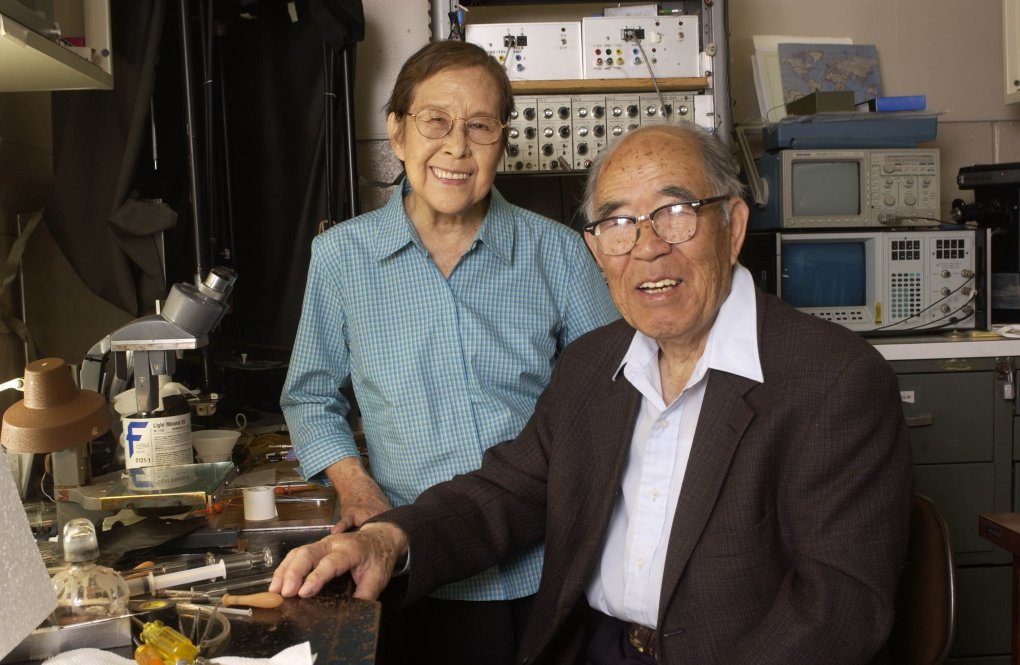
Ichiji Tasaki spent seventy years quietly demonstrating that this picture was incomplete.
Tasaki discovered saltatory conduction, the mechanism by which myelinated axons transmit impulses by leaping between nodes of Ranvier rather than propagating continuously along the membrane. This finding, made in Japan in the 1930s using hand-built instruments, underpins everything we understand about myelinated nerve function. It is in every biology textbook. His name is in almost none of them.
After this foundational contribution, Tasaki spent the rest of his career pursuing an observation that most of his colleagues found inconvenient. When an axon fires an action potential, it twitches. Not metaphorically. Physically. The axon membrane swells outward by fifty to a hundred angstroms, a movement so small it requires high magnification and careful video recording to capture, but real, reproducible, and measurable by three independent methods.
This mechanical response to electrical excitation was documented in a 1980 paper in Science, co-authored with Kunihiko Iwasa and Robert Gibbons. It was largely set aside by mainstream neuroscience as an interesting curiosity with no obvious biological function.
Tasaki did not set it aside. He spent the following decades investigating what this mechanical response meant for our understanding of how nerve impulses actually propagate.
The biophysicist and the field researcher
R. Douglas Fields spent years investigating how myelin-forming cells know when to myelinate. The question was not trivial. Myelination is activity-dependent, it responds to the pattern and intensity of axonal firing, but oligodendrocytes and Schwann cells are not at synapses where neurotransmitters are released. How do they detect axonal activity?
Fields narrowed in on ATP as the likely signalling molecule. ATP is universal, scarce outside cells, and detectable by receptors on myelinating glia. The question was how ATP gets from a firing axon to the surrounding glial cells when there are no synapses involved.
One day, reviewing time-lapse video of axons at high magnification, Fields noticed something. The axon twitched when stimulated to fire. He visited Tasaki at his NIH laboratory to ask whether he was seeing an artefact.
Tasaki confirmed it was real. He sketched the mechanism. When an axon fires, ions and water molecules cross the membrane, causing the cytoplasm near the membrane to swell. This swelling activates volume-regulation channels, which open to release small molecules including ATP to restore normal cell volume.
The twitching axon, dismissed for decades as a byproduct with no biological purpose, turned out to be the mechanism Fields needed. Axonal firing causes mechanical swelling. Mechanical swelling releases ATP through volume-regulation channels. ATP signals to nearby myelinating glia. Myelinating glia respond by regulating the development and maintenance of the myelin sheath.
Fields spent nine years testing and confirming this chain. The results established three distinct molecular mechanisms by which axonal impulse activity signals to myelinating cells, with ATP release through mechanical membrane activity as a central component.
What myelin wraps around
The standard picture of myelination presents the myelin sheath as a response to the axon’s electrical properties. A sufficiently large axon acquires myelin to enable faster and more efficient signal transmission.
The Tasaki-Fields chain suggests something richer. The axon is not merely an electrical conductor. It is a mechanically active structure whose physical movements, however microscopic, carry information to the cells that wrap around it. The myelinating cell is not simply responding to an electrical signal. It is responding to the physical activity of the axon it is in contact with, through the chemical language of ATP released by mechanical movement.
Myelin wraps a twitching axon. The spiral sheath is not insulating a passive wire. It is embracing a structure that pulses, however slightly, with every impulse it carries. The accumulated myelinated condition is not simply the record of electrical activity in a circuit. It is the biological response to the physical life of the axon, inscribed through a mechanism that couples mechanical movement to chemical signalling to structural change.
This is a different picture from the one neuroscience has been drawing. It is not a dramatic difference at the level of mechanism. But it shifts the conceptual frame considerably. The axon is not a wire that myelin insulates. It is a living structure whose activity, including its physical activity, shapes the glial response that builds and maintains the sheath around it.
Tasaki’s deeper proposal
Tasaki did not stop at demonstrating that axons swell mechanically during action potentials. In his later theoretical work, particularly his 2004 paper on conduction velocity in nonmyelinated fibres, he proposed a physicochemical model of nerve impulse propagation built on this swelling mechanism.
In this model, the propagating nerve impulse is understood as the movement of a boundary between two structurally distinct regions of the axon, one swollen and active, one shrunken and resting. The electrical changes associated with the action potential are real, but they are, on this account, the consequence of these structural transitions rather than their primary cause.
This is a minority position in neuroscience. The Hodgkin-Huxley model of nerve excitation, built on ion channel kinetics and membrane potential changes, remains the dominant framework. Tasaki’s physicochemical alternative has not displaced it.
But the minority position has not been disproven. And it has something to recommend it beyond Tasaki’s authority, which is considerable. Several subsequent researchers have investigated mechanical wave propagation in nerve fibres as a complement to or component of electrical conduction. The observation that action potentials are accompanied by mechanical waves in the axon membrane has been confirmed in multiple independent studies.
Whether the mechanical wave is the primary phenomenon or a consequence of the electrical one remains, honestly, unresolved. Tasaki believed the former. Most neuroscientists assume the latter. The question has not been definitively settled.
The resonant structure
What does any of this mean for the Myelin Mind?
The thesis proposes that myelin is not insulation but the accumulated biological condition of the nervous system, built through a history of encounter with the world and making that history available to every subsequent incoming signal. The chiasm between the incoming signal and the accumulated myelinated condition is where experience arises.
If the axon is not simply an electrical conductor but a mechanically active structure whose physical movements participate in signalling to the myelinating cell, then the accumulated condition is being built through a richer coupling than the electrical model suggests. The myelinating cell is not simply counting action potentials. It is responding to the physical life of the axon, to its mechanical activity, to the ATP released by its twitching membrane, to the full biological reality of a structure that is alive and moving and signalling in multiple registers simultaneously.
Myelin wrapping a mechanically active axon is not insulation around a wire. It is a living structure that has grown in response to the physical activity of what it embraces, shaped by the mechanical as well as the electrical history of that activity, carrying that history forward as the accumulated condition that every subsequent incoming signal must meet.
The resonant structure argument, that myelin is best understood as something that vibrates in sympathy with the world rather than something that insulates against it, finds a biological foundation in Tasaki’s twitching axons and Fields’ nine years of patient investigation.
The axon twitches. The myelinating cell listens. The sheath raps (wraps) in response to what it hears.
Jack Parry is a philosopher, polyglot and biomedical animator at Swinburne University of Technology. He is the author of The Myelin Mind: The Genesis of Meaning.