keywords: time travel
Time is in the eye of the beholder.
We experience time as a line because we are creatures of the eye. The eye projects from a single point of observation outward to a horizon. It creates perspective, vanishing points, the organised recession of space from near to far. And because visual experience is so dominant in the human nervous system, we have imposed its geometry onto everything, including time. Past on the left, future on the right, the present moment a moving point on a line that extends in both directions toward infinity.
This is not what time is. It is what time looks like to a visually organised nervous system.
Ask your nose. It tells a completely different story.
The geometry of the eye
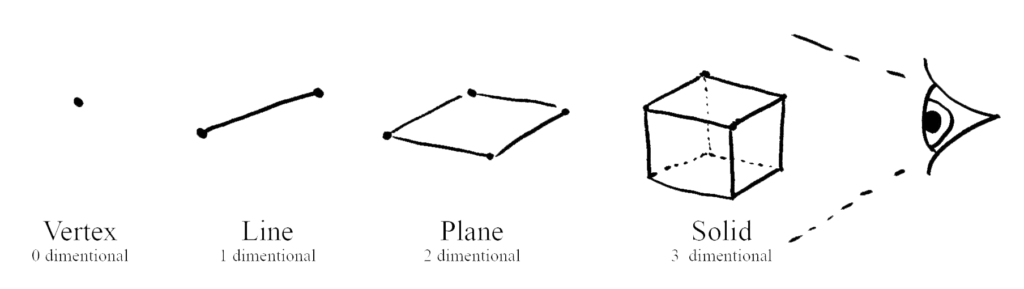
The Cartesian coordinate system, X, Y and Z, was derived from the geometry of the eye. A single observer, a cone of vision projecting outward, space organised around the straight line from here to there. When Descartes formalised this into mathematics he was not describing an objective feature of the universe. He was describing the spatial experience of a creature with two forward-facing eyes and a strong preference for straight lines.
When Einstein added time as a fourth dimension to this geometry he extended a framework that was already built for visual creatures. His spacetime is the universe as seen from inside a skull organised around the horizon.
Bergson noticed the problem in 1922 and could not quite name it. Lived time, duration, does not feel like a fourth spatial dimension. It feels thick, layered, accumulated. The present moment is not a point on a line. It is the whole weight of everything that has happened pressing into what is happening now.
The Myelin Mind gives Bergson the mechanism he was missing. Time is not a dimension added to space. Time is the accumulated myelinated condition pressing into the present moment at every chiasm. The past is not behind you on a line. It is inside you in the white matter, layer upon layer, the innermost ring the newest, the outermost the most ancient, all of it simultaneously present in the structure that every incoming signal must pass through.
The timeline is what the eye sees. Duration is what the myelinated rhizome becomes.
The nose and the oldest rhizome
With the olfactory system the geometry changes completely.
Every other sense passes its signal through the thalamus, the relay station of the brain, before it reaches the cortex. The thalamus is where sensory signals are processed, filtered, contextualised and sent to the appropriate cortical region. This relay introduces a kind of temporal processing. The signal is handled, organised and placed in the context of the present moment before it reaches awareness.
The olfactory pathway bypasses this relay almost entirely. It connects directly from the olfactory bulb to the limbic system and the hippocampus, the structures most deeply involved in emotional memory and the consolidation of experience into the accumulated condition. It reaches the oldest and most deeply myelinated structures in the nervous system before it reaches anything that processes it in terms of the present moment.
This is not a minor anatomical detail. It is the biological explanation for something every human being has experienced and nobody has adequately explained.
The smell of a pine tree. The Christmas tree carried into the house in December…
For a child who grew up in the Soviet Union, the smell of a birch tree…
The particular dusty stillness of a grandmother’s pantry, closed now for years because she is gone.
These smells do not remind you of the past.
They return you to it.

Not metaphorically. The incoming olfactory signal bypasses the temporal processing of the thalamic relay and arrives directly in the accumulated condition at the layer where that smell was first inscribed. The myelinated rhizome is a time crystal, the innermost layer the newest, the outermost the most ancient. The olfactory signal reaches through the layers to the point of original inscription and activates it directly.
The interval between then and now collapses. Not because time has reversed. Because the olfactory pathway does not process its signal through the temporal organisation that the visual system imposes. The smell of the Christmas tree is not placed in the present moment and compared to a memory of the past. It arrives in the past directly, finding the accumulated condition at the moment of first inscription, and the past is suddenly not past at all.
That is biological time travel. Not through clock time. Through the myelinated rhizome. The olfactory pathway is the oldest time machine available to the human nervous system and it has been operating in every person who has ever smelled something that reached all the way back.
Proust had the experience. The Myelin Mind has the mechanism.
Marcel Proust described this with more precision than any neuroscientist of his era could have managed. The madeleine dipped in lime-blossom tea. The involuntary memory that is different in kind from voluntary recollection. The way the past does not return as a representation but as a presence, immediate and total, the whole lost world of Combray arriving not as a thought but as an experience.
He could not say why it happened with smell and taste rather than sight. He knew that it did and described it from the inside with extraordinary care. The neuroscience has since confirmed the directness of the olfactory pathway and its connection to memory, but without the Myelin Mind framework it has described the mechanism without explaining the phenomenon. Knowing that the olfactory bulb connects directly to the hippocampus does not tell you why the grandmother’s pantry returns her rather than merely recalling her.
The Myelin Mind tells you why. The smell arrives in the layer of the accumulated condition where she was first inscribed. The time crystal rotates. The distance between 1978 and 2026 is not abolished by the smell. It is revealed to have never been the kind of distance the timeline suggested. The linear timeline is the eye’s way of organising experience. The olfactory rhizome has a different geometry entirely.
What the nose knows that the eye doesn’t
The eye produces space. It projects outward from a point, organises the world along straight lines of perspective, creates the horizon that makes a timeline possible.
The cochlea produces spiral time. Music. The return of themes. The accumulated weight of what has already sounded pressing into what is sounding now.
The nose produces something closer to what Bergson was trying to describe. Not space. Not spiral time. The simultaneous presence of the accumulated condition in its entirety, activated at its deepest layer by a signal that bypasses the editorial management of the thalamic relay and arrives directly where it needs to go.
A neuroscience organised around the eye has given us the timeline, the snapshot, the moment, the scan. It has given us a picture of the brain as a spatial object processing information along linear pathways.
A neuroscience organised around the nose, around the olfactory rhizome as the model of how accumulated condition meets incoming signal, would look completely different. It would be organised around depth rather than distance, around the simultaneous presence of all myelinated layers rather than the sequential processing of discrete moments, around duration in Bergson’s precise sense rather than clock time in Einstein’s spatial sense.
The Myelin Mind is that neuroscience. It just took the smell of a Christmas tree to show where it was pointing all along.
Jack Parry is a philosopher, polyglot and biomedical animator at Swinburne University of Technology. He is the author of The Myelin Mind: The Genesis of Meaning.