keywords: nystagmus migraine myelin
I have suffered visual migraines since adolescence. Not the kind that announces itself with pain and retreats quietly. The kind that arrives first as a disturbance in the fabric of vision: a flickering arc, a shimmer at the edge of sight, a slow geometric intrusion that spreads across the visual field over twenty or thirty minutes before the headache hits. Neurologists call this a migraine aura. I have come to think of it as a tear in the fabric of perception. Not a hole, exactly. More like a place where the fabric has been pulled apart and something else is showing through underneath.
For most of my life I treated the aura as a warning. The real event, the headache, was coming. The aura was merely the announcement. But sometime in my forties, thinking about the nature of visual experience through the lens of what would become the Myelin Mind thesis, I began to wonder whether the aura was something more interesting than a warning. Whether it was, in fact, a window.
The question I found myself asking was this: if migraine aura is a hallucination, in the strict sense of a perceptual experience generated without corresponding sensory input, then where does it live? Not anatomically, but phenomenologically. Is it part of the visual field, subject to the same instabilities and disruptions as ordinary vision? Or is it generated at a different level of the perceptual architecture, one that sits above or behind the incoming visual signal?
I designed an experiment to find out. It was not comfortable.
The experiment
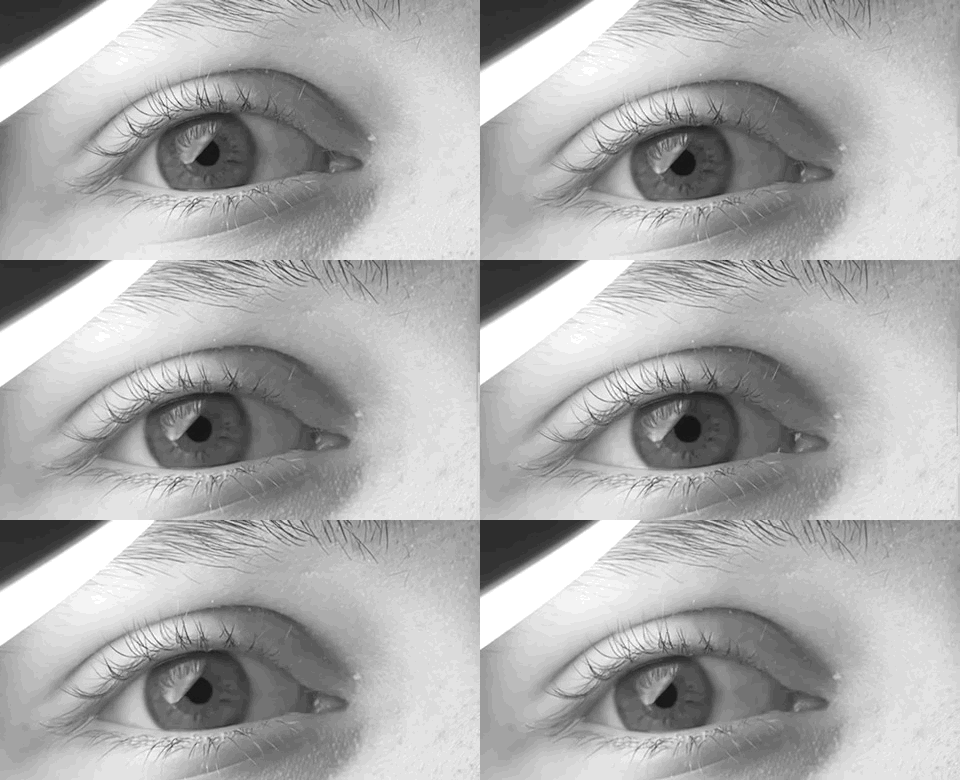
The logic was straightforward, even if the execution was not. Nystagmus is a condition in which the eyes oscillate involuntarily, typically as a result of disturbance to the vestibular system. It can be induced in a healthy person by prolonged rotation, which overstimulates the semicircular canals of the inner ear and produces, on stopping, a powerful and disorienting illusion that the world is spinning. The eyes respond by attempting to track the apparent rotation, flicking back when they reach the limit of their range in a characteristic triangular wave: slow pursuit in one direction, rapid reset, slow pursuit again. The world, from the inside of this experience, does not hold still.
My hypothesis was that if migraine aura were a disturbance of visual processing, a malfunction somewhere in the circuitry that handles incoming visual signal, then inducing a simultaneous and powerful vestibular crisis should interfere with it. Two disturbances of the same system should interact: competing, compounding, or cancelling. But if the aura were generated at a different level entirely, above or behind the incoming signal, then the vestibular crisis should leave it untouched. The hallucination and the dizziness should occupy different perceptual spaces and fail to interact in the way two disturbances of the same circuit would.

I waited for a migraine. When the aura began, fully established and spreading across my right visual field, I began to spin. I was in a controlled environment, seated, with no risk of injury. I spun for six minutes without stopping.
When I stopped, I fixed my gaze on the point where I knew a clock on the wall in front of me would be.
So What Happened?
The world was spinning. That was expected. What was not expected was what happened to the aura.
It held still.
As my perception of space rotated around me, the aura remained fixed at the point where the clock was. Not approximately fixed. Precisely fixed. The tear in the fabric of perception did not move with the spinning world. It did not drift or oscillate or blur. It sat exactly where it had been, anchored to a point in space with a stability that nothing else in my visual field possessed in that moment.
And then the reset pattern declared itself. The world did not spin continuously. It rotated approximately fifty degrees and then snapped back. Not to a neutral point, not to the position the world had been in before I started spinning, but to the aura. To the tear. To the only thing that was not moving. Then it rotated again, this time perhaps forty-five degrees, and snapped back again. To the aura. A triangular wave: slow rotation in one direction, rapid reset to the fixed point, slow rotation again. Each reset returning to the same anchor.
My eyes were not moving. I could feel that they were still. But my perception of space was rotating and resetting, rotating and resetting, with the aura as its invariant reference point. The hallucination was the most stable thing in the room. Everything real was moving around it.
Eventually the two converged. The rotation slowed. The aura faded. The splitting headache arrived, as it always does, to end the proceedings.
I repeated the experiment three times over the following months, each time waiting for a fully established aura before inducing the vestibular crisis. Each time the same result. The aura held still. The world rotated around it. The reset pattern appeared each time, snapping back to the tear with a consistency that felt, from the inside, less like chaos and more like a system doing exactly what it was designed to do.
A note for any migraine sufferer curious enough to attempt a replication: I discovered that both rum and whiskey induce visual aura reliably in me. The experimental schedule, it turns out, does not require waiting for a spontaneous event.
What the wired mind makes of this
The standard account of migraine aura identifies it as a cortical spreading depression: a wave of electrical and metabolic change that moves slowly across the visual cortex, disrupting normal processing and generating the characteristic visual disturbance. On this account, the aura is a malfunction of the visual processing system. It is something going wrong in the circuitry.
If this account is correct, then what I observed should not have happened. A malfunction in the visual processing circuitry, subjected simultaneously to the most powerful vestibular disruption a healthy person can voluntarily induce, should have been destabilised, displaced, overwhelmed or at minimum altered. The two disturbances should have interacted, because they are disturbances of the same system.
They did not interact. The aura was untouched. More than untouched: it became the anchor around which the disrupted system organised itself. The malfunction, if that is what it is, proved more stable than the function.
The wired mind has no clean explanation for this. The Myelin Mind has a suggestion.
Migraine: A tear in a different fabric
The Myelin Mind argument is that consciousness arises not from neural activity alone but from the encounter between incoming neural signal and the myelinated structure of accumulated experience. Grey matter carries the present signal. White matter carries the accumulated condition of everything that has been experienced before. The chiasm, the encounter between them, is where experience happens.
Migraine aura, through this lens, is not a malfunction of visual processing. It is a decoupling. The myelinated visual structure begins generating experience independently of incoming signal. The tear in the fabric of perception is not a hole in the visual processing system. It is a place where white matter has uncoupled from grey matter and is running on its own, generating visual experience from its accumulated condition without waiting for the world to provide the input.
If this is right, then the aura’s stability during the vestibular crisis makes immediate sense. The vestibular crisis disrupts the incoming signal: the semicircular canals are overwhelmed, the spatial orientation system is flooded with contradictory information, the grey matter is in chaos. But the aura is not dependent on grey matter. It is white matter generating experience from within. The chaos in the incoming signal cannot touch it, because it is not listening to the incoming signal. It is, for the duration of the aura, entirely its own phenomenon.
And it becomes the anchor precisely because it is the only thing in the perceptual field that is not grey matter dependent. Everything else depends on incoming signal for its stability. The aura depends on nothing incoming. It simply is, with a certainty that the signal-dependent world cannot match in that moment.
Nystagmus: The triangle wave
The reset pattern connects the phenomenology of my experience to an observable feature of nystagmus that I only fully understood later.
In observable nystagmus, the characteristic eye movement is a triangular wave: slow drift in one direction, rapid corrective flick back, slow drift again. The slow phase is the vestibular system’s attempt to stabilise gaze on a reference point as the perceived world rotates. The fast phase is the reset when the eye has tracked as far as it can go and must return to find the reference point again. The eye is not malfunctioning. It is doing exactly what the oculomotor system is designed to do: trying to hold a reference point stable in a rotating world.
My eyes did not move during the experiment. But my perceptual system produced exactly the same triangular wave pattern, phenomenologically, that nystagmus produces observably. The slow rotation, the rapid reset, the consistent return to the same anchor. The internal experience of the reset mechanism without the external expression of it.
This raises a question I have not seen asked in the nystagmus literature. What do nystagmus patients actually experience from the inside? If my perceptual system was doing internally what a nystagmus patient’s eyes do externally, then perhaps nystagmus patients experience not a uniformly unstable visual field but something more structured: a world that rotates and resets, with whatever stable reference the perceptual system can find serving as the anchor each time. The eye flick is not the malfunction. It is the repair attempt.
There is a further question beneath this one. The semicircular canals and the visual system share white matter. The oligodendrocytes maintaining the vestibular pathways and those maintaining the visual pathways are neighbours, in some cases wrapping adjacent axons in shared white matter territory. If the triangle wave I experienced was not purely visual and not purely vestibular, but an artefact of a shared white matter substrate reconciling two incompatible signals, then the question that follows is one the Myelin Mind is uniquely positioned to ask: can one form of neural activity influence a structurally distinct but oligodendrocyte-adjacent form of perception, not through synaptic connection, but through the shared physical medium of the myelinated environment? Not grey matter to grey matter, but white matter to white matter, through the living tissue both systems share.
I offer this not as a conclusion but as a question that does not easily go away.
The Dress
In 2015, an image circulated on the internet that briefly divided the world into two camps. A photograph of a dress: some people saw it as white and gold, others as black and blue. The disagreement was not about taste or interpretation. People were genuinely seeing different colours in the same image, and neither group could understand how the other was possible.
The neuroscience of the dress has been discussed extensively. It is, at its core, a demonstration of how powerfully the brain’s assumptions about ambient lighting can override the raw data of the incoming visual signal. The white-and-gold perceivers were assuming a warm light source and discounting it. The black-and-blue perceivers were assuming a cool light source and discounting that. Same image, different myelinated assumptions, different experiences.
I became fascinated by the dress for a different reason. I discovered that I could switch between the two percepts voluntarily. Not accidentally, not by being told which to look for, but by an act of will: by deliberately shifting the myelinated assumption that was being applied to the incoming signal. White and gold. Black and blue. Back again. At will.
I practised this. I got good at it. Very good at it. I could switch rapidly, hold one percept, release it, take the other. I understood, through the Myelin Mind lens, exactly what I was doing: I was exercising deliberate volitional control over the chiasm, forcing white matter to reinterpret the same grey matter signal, twice, in rapid succession, by an act of conscious intention.
One evening, feeling what I can only describe as supremely powerful in my levels of perceptual self-control, I pushed harder.
I felt a stab. A profound, sudden, localised pain, deep in the right side of my head. Not like a headache. Like something giving way.
I went to sleep.
I woke up blind.
What I understand now
The blindness was in my right visual field. The same field where the migraine aura had always appeared. The same territory where, for years, I had been observing the decoupling of white matter from grey matter as a controlled phenomenological investigation. The same region I had been exercising, deliberately and with increasing intensity, in the weeks before the event.
The clinical diagnosis was a TIA: a transient ischaemic attack, a temporary interruption of blood supply, in the left occipital lobe. Not a full infarct. The vision returned. But it returned to a different visual world, one that I have described in detail elsewhere in this series, a world where the right visual field was reconstructed by white matter rather than delivered by the incoming signal, where text disappeared but faces held, where the myelinated structure of accumulated experience proved both more and less reliable than anyone had predicted.
I am not claiming that the dress caused the stroke. Correlation is not causation, and a philosopher should know better than most the difference between a compelling narrative and a demonstrated mechanism. What I am saying is that it was not random. The aura had been appearing in the right visual field since adolescence. The experiments had been conducted in that territory for years. The volitional perceptual switching was being practised with increasing intensity in exactly that region. And the event, when it came, came there.
The tear in the fabric of perception, which I had spent years studying as a window into the architecture of consciousness, turned out also to be a fissure. I had been looking through it for so long that I had not noticed it was getting wider.
A note on method
I am aware that a self-experiment conducted three times, by a single subject, without instrumentation or independent observation, does not constitute clinical evidence. I offer it as a phenomenological report, made by someone with the theoretical framework to know what they were looking for and the philosophical training to describe what they found.
Oliver Sacks built a body of work on exactly this kind of careful, honest, first-person observation. He did not apologise for looking closely at what was in front of him, even when what was in front of him was his own experience. The neurological case history is a legitimate form of evidence. It cannot stand alone, but it can point.
Someone with the right instruments ought to run this experiment. The equipment required is not exotic: a migraine sufferer willing to endure the protocol, a rotating chair, a method for tracking eye movement, and a way of recording the reported position of the aura relative to the observed reset pattern. The question of whether the perceptual reset and the oculomotor reset are the same phenomenon observed from different sides of the chiasm is, I think, answerable.
I just needed a clock on the wall, six minutes of spinning, and eventually, though I did not know it at the time, a dress on the internet, to know it was worth asking.
Jack Parry is a philosopher, polyglot and biomedical animator at Swinburne University of Technology. He is the author of The Myelin Mind: The Genesis of Meaning.