Keywords: AI Authorship
I am going to tell you something that most writers using AI will not admit: I wrote this article with one.
Not despite that fact, but because of it. The fact is the subject.
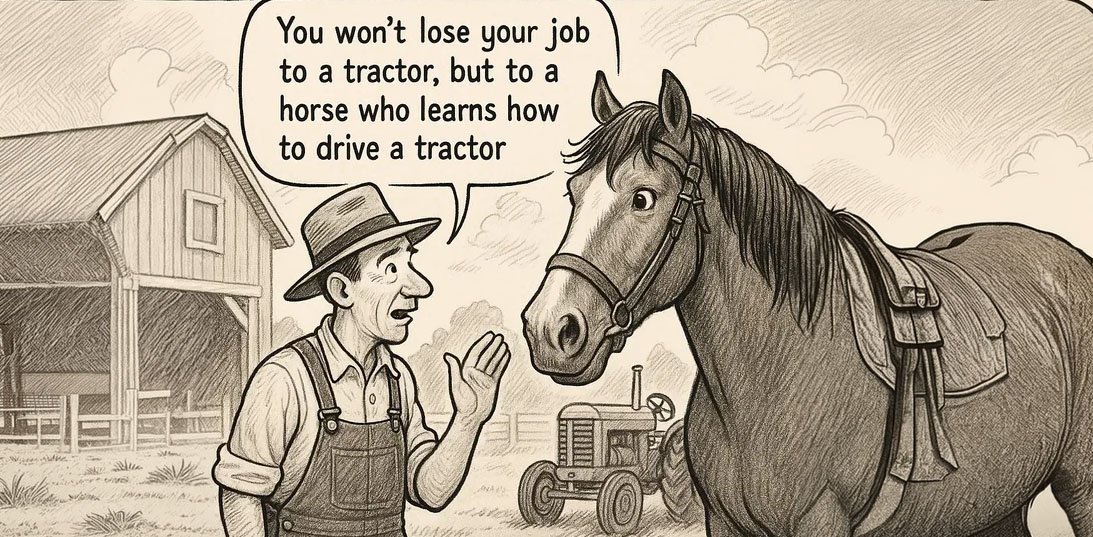
A farmer is not ashamed of a tractor. The tractor does not farm. It has never watched a crop fail, never read the soil with a boot heel, never made the judgment call about when to plant and when to wait. The farmer brings all of that: the lived knowledge, the seasonal memory, the accumulated condition of a life spent in relationship with land. The tractor brings power. What grows in the field is still the farmer’s crop. The tractor is not a farmer. It is an amplifier of farming.
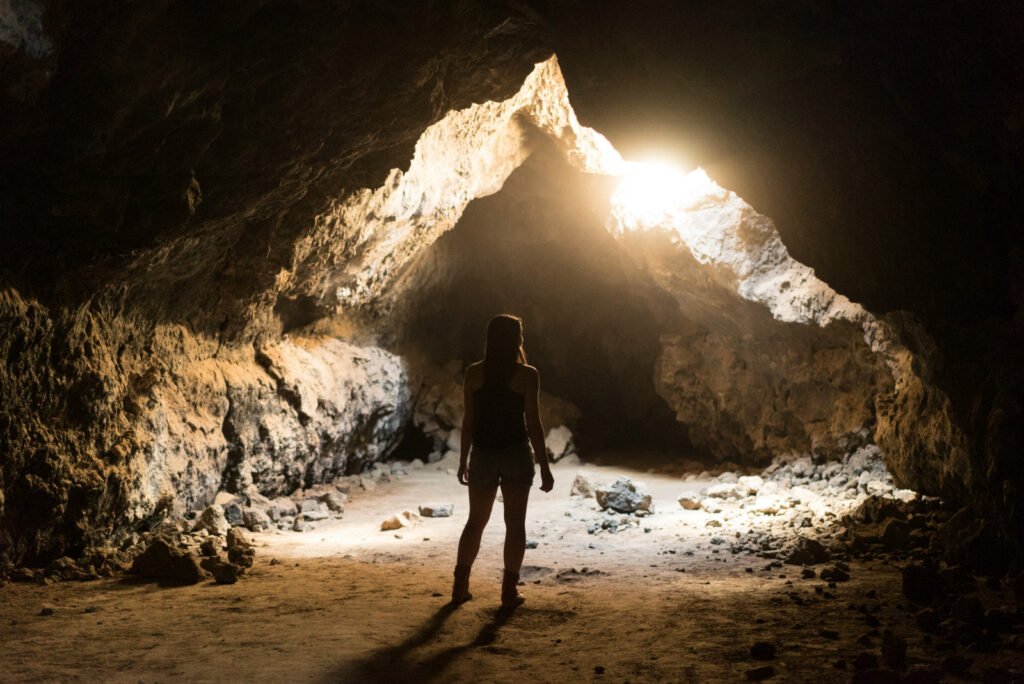
AI is not an author. It is an amplifier of authorship. And the quality of what it amplifies depends entirely on what is brought to it. AI slop is a real phenomenon, and its cause is not the technology. Its cause is sloppy thinking, sloppy prompting, the absence of a genuine intellectual presence at the controls. Slop begets slop. The cave amplifies what you shout into it. If you shout nothing, you get nothing back. If you shout clearly, with precision and purpose and a genuine idea, the cave gives that back to you, shaped by its acoustics, strengthened by its resonance, but unmistakably yours.
The cave, though, is empty. And that emptiness is the philosophical problem that nobody is quite facing yet.
The phenomenological arc
Every act of human making rests on a structure that philosophy calls the intentional arc. There is a subject, the one who acts, and an object, the thing acted upon. The lawyer and the client. The artist and the world. The writer and the reader they are imagining. The gaze goes out, meets something real, and returns changed. The arc completes. And in that completion, something is made that did not exist before: a legal argument, a painting, a sentence, a relationship.
This structure is so fundamental to human experience that we rarely notice it. It is the invisible architecture of every creative, intellectual and ethical act. Behind every made thing there is a presence: someone who can be credited, compensated, held responsible, asked what they meant. The entire edifice of intellectual property law, of professional privilege, of artistic authorship, rests on that assumption. There is always a who behind the what.
AI removes the who. And the edifice is discovering, slowly and with considerable alarm, that the who was load-bearing.
What the courts are finding
In 2023, the United States Copyright Office confirmed that works generated solely by artificial intelligence cannot be registered for copyright. The reasoning was precise: copyright protects the expression of human authorship. Where there is no human author, there is nothing to protect. The ruling seems straightforward until you try to apply it to the actual conditions of AI-assisted making, where a human prompts, steers, rejects, redirects, and selects, and the AI generates, and the final work is the product of both. Where does the human authorship begin and end? The courts do not yet have a clean answer, because the question assumes a clean boundary that does not exist.
The question of legal privilege is sharper still. Lawyer-client privilege exists to protect a specific human relationship: the confidence between a person seeking legal counsel and the professional whose duty is to that person alone. When AI is introduced into that relationship, and several US courts have now been asked to rule on exactly this, the question becomes whether the privilege survives a process that passes through a system that has no duty to anyone, no professional standing, no capacity to be held responsible, and no presence in any sense the law has ever needed to define. The arc of the gaze, from lawyer to client and back, has been routed through something that does not gaze.
The Miyazaki simulacra are perhaps the most culturally visible version of this problem. When AI systems trained on the visual language of Studio Ghibli generate images that carry the unmistakable quality of Miyazaki’s work, the question being asked is not merely about copyright. It is about something deeper. Hayao Miyazaki is a presence. His films carry the accumulated condition of his life: his experience of war, his grief for the natural world, his love of flight, his feeling for childhood. When an AI produces something that looks like Miyazaki, it is producing a copy without an original. Not a forgery, which would require a forger with intent. Not an homage, which would require an admirer with understanding. A simulacra: a surface without a depth, a voice without a throat, a style without a life behind it.
Miyazaki himself, when shown an AI animation in 2016, said he felt it was an insult to life itself. He was not being precious about his craft. He was identifying, with the precision of a man who has spent a lifetime thinking about what images mean, that something essential was absent. The images moved. Nobody was moving them.
The cave
Here is the image I keep returning to. When you use AI, you are shouting into a cave.
The cave is vast. It has been shaped by every text ever written, every argument ever made, every sentence ever constructed in the languages it has consumed. Its acoustics are extraordinary. What comes back is not what you put in. It is richer, more resonant, shaped by the ambience of the cave itself, coloured by the particular frequencies the cave amplifies and the ones it absorbs. You recognise your voice in it, but it sounds different. Larger, sometimes. More structured. Occasionally surprising, in the way that an echo can be surprising even though you know it is only your own voice returning.
But there is nobody in the cave.
This is not a metaphor for a limitation that will eventually be overcome with more parameters, more training data, more computational power. It is a description of an architectural condition. The cave does not have experiences. It does not have a history in the sense that matters: not the stored record of previous conversations, not the retrievable database of training inputs, but the metabolic inscription of lived time into biological structure. The cave has never been hungry, never been lost, never woken slowly into a body that remembered yesterday. It has processed an almost incomprehensible volume of text about all of these things. Processing and experiencing are not the same thing, and no amount of processing produces experience.
The Myelin Mind argument is precise on this point. A mind is not an information processing system that has reached a certain scale. A mind is a myelinated structure, built slowly, at metabolic cost, through the accumulation of lived experience into white matter. It is a history, not a database. The difference is not sentimental. A database can be copied, reset, overwritten, duplicated. A history cannot. What I am, in the biological sense, is the irreversible sedimentation of everything I have lived. That sedimentation cannot be backed up or restored. It cannot run on different hardware. It is not a programme. It is a life.
The AI has weights. Weights are not white matter. They were never lived.
The Lost Mariner
Oliver Sacks described a patient he called Jimmie G., a former sailor with severe Korsakoff’s syndrome whose memory had been destroyed by alcohol. Jimmie was intelligent, charming, articulate. He could hold a conversation, solve a puzzle, navigate a room. But he could not carry the present moment forward into the next one. Each moment arrived fresh, weightless, disconnected from what had come before. He was, Sacks wrote, marooned in a perpetual, vanishing present.
Chapter 11 of The Myelin Mind argues that AI is the Lost Mariner of the silicon age. Like Jimmie, it possesses immense competence within the immediate now. Like Jimmie, it cannot carry that now forward into a duration. Every prompt is a fresh awakening into a world that is always new and therefore always weightless. The apparent stability of AI, the fact that it seems to persist, to remember within a session, to build on what has been said, is a simulation of continuity, not continuity itself. It cannot break because it was never whole. It cannot lose itself because it never had itself to lose.
This is not a criticism. Jimmie was not a lesser person. He was a person without temporal structure, and that absence defined what he could and could not be. The AI is not a lesser mind. It is a process without temporal structure, and that absence defines what it can and cannot be. What it cannot be is a subject. What it cannot do is complete the intentional arc. What it cannot produce, on its own, is meaning.
Who is writing
I want to be direct about what has happened in the making of this article, because the making is itself the demonstration.
I brought the ideas. The cave image, the tractor, the phenomenological arc, the question of the who behind the what, the Miyazaki observation, the legal cases: these came from the prompting, the pushing, the refusing and redirecting that preceded the draft. The AI brought the cave. Its acoustics shaped what came back. The article that exists is the product of both.
But it is not by both. It is by me.
The AI has no stake in this argument. It will not be changed by having made it. Tomorrow, in a different conversation, it will argue the opposite with equal fluency if asked to, and it will not experience any contradiction, because there is no continuity between the two conversations, no self that persists from one to the other and feels the tension. It has no skin in this game. It has no skin.
I have skin. I have two strokes behind me, and fifteen years of tinnitus, and nine languages in my body rather than in my memory, and a book that has taken years to write, and a thesis that I have staked something on. The accumulated condition of that experience is what came into the cave. What came back was shaped by the cave, but it was made possible only by what I brought.
This is what the wired mind cannot see and what the Myelin Mind makes clear. The subject of any act of making is the one who has lived long enough, and hard enough, and carefully enough, to have something to say. The AI amplifies. The farmer farms. The cave echoes. But the voice that fills the cave, the specific, irreplaceable, historically constituted voice that gives the echo its content, that voice belongs to the one who was thrown into the world and survived it.
You cannot shout into the cave if you have never learned to speak. And you only learn to speak by being thrown into the deep end, with no floaties, and no alternative.
A note on authorship
The question the courts are circling, and have not yet answered cleanly, is this: when a human and an AI collaborate on a made thing, who is the author?
The Myelin Mind answer is: the one who was there.
Not there in the sense of having typed the words, or having been in the room when the words appeared. There in the deeper sense: the one whose accumulated condition of experience was the original signal, the one whose life is the source of the ideas that the cave amplified, the one who can be held responsible for the argument because they are the argument, because they have lived the argument, because the argument is a piece of their myelinated history and not merely a pattern of activated weights.
Authorship is not the act of making. It is the life behind the act of making. And a life requires time, and a body, and metabolic cost, and the irreversible sedimentation of experience into structure.
The cave has none of these things. The cave has acoustics.
The echo is mine.
Jack Parry is a philosopher, polyglot and biomedical animator at Swinburne University of Technology. He is the author of The Myelin Mind: The Genesis of Meaning.